Will AI Replace My CRM Job in 2026?
CRM, AI in Sales, Job Security, Indian SMBs
Will AI Replace My CRM Job?
An honest, research-backed 2026 answer for sales professionals, CRM users, and business owners in India who are worried about what AI really means for their careers.

If you are in sales or manage CRM today, you are not imagining it — the fear is real. Recent surveys show that 59% of salespeople worry that AI could displace their jobs, and many quietly ask their colleagues, “Will AI replace my CRM job?” without saying it in front of their manager.
Here is the honest answer, without cheerleading or doom: AI is already replacing specific tasks inside CRM work — but it is not replacing complete jobs where humans build trust, use judgment, and own relationships. That distinction changes everything about how you should respond in 2026, especially if you are a sales professional or business owner in India.
The more useful question is not “Will AI take my job?” but “Which parts of my job will AI take — and how do I use it so I can do more than my competitors?” This article gives you a task-by-task breakdown, the latest data, and a practical action plan tailored to Indian SMBs, so you can move from anxiety to strategy.
The Fear Is Real — But the Data Tells a More Nuanced Story
Let us start by respecting the fear. In 2026, AI is no longer a buzzword on conference slides. It writes emails, answers leads on WhatsApp, scores prospects, and even books meetings while you sleep. For many, it feels like a silent competitor sitting inside the CRM, working faster and cheaper than any human can match. No wonder “AI replacing sales jobs 2026” is such a common search term.
But when you look at the global data, a different picture appears. The World Economic Forum’s Future of Jobs 2025 report projects a net gain of around 78 million jobs globally by 2030, with “sales representatives” and “sales and marketing professionals” explicitly listed among the fastest-growing roles as companies adopt AI, not the ones disappearing (World Economic Forum, 2025).
In parallel, labour outlook data shows that sales remains a major hiring category. The U.S. Bureau of Labor Statistics projects around 1.8 million sales job openings per year through 2034, driven by turnover and growth — hardly a sign of a dying profession. The question is not whether sales disappears, but which type of sales work grows, and which shrinks.
Inside sales teams, AI is already mainstream. LinkedIn’s 2025 data suggests that 56% of sales professionals use AI tools daily, and G2’s State of AI in CRM finds that 73% of AI CRM users say it makes their teams more productive, not redundant. The Salesforce State of Sales 2026 report goes further: 85% of reps using AI say it frees them for higher-value work, and 82% report better career prospects as a result (Salesforce, State of Sales 2026).
So the fear is not “wrong” — it is just aimed at the wrong target. AI is not coming for salespeople who close deals and manage relationships. It is coming for the repetitive, transactional tasks that sit around those relationships. That is where the real disruption — and the real opportunity — lives for the future of CRM jobs India.
What AI Already Replaces in CRM Work (Be Honest)
To answer “will AI replace my CRM job?” honestly, we have to list the tasks AI is already better at than most humans — without sugar-coating it. According to Salesforce, reps still spend around 70% of their time on non-selling work: updating records, logging calls, chasing documents, and building lists. That 70% is exactly what AI-powered CRMs attack first (Salesforce, State of Sales 2026).
- CRM data entry and hygiene. AI can auto-log calls, parse emails, capture WhatsApp chats, and update contact fields without you touching the keyboard. In Indian SMBs, this often means 1–2 hours of “evening admin” disappears overnight.
- Lead list building and enrichment. Instead of manually searching LinkedIn or Justdial, AI can scrape, segment, and enrich lead lists, then push them into your CRM with tags and scores attached.
- Basic email and WhatsApp sequencing. AI can generate first-touch messages, nurture sequences, and reminders at scale — personalised enough to be relevant, but still formula-driven under the hood.
- Meeting scheduling and reminders. Bots can send calendar links, propose slots, confirm attendance, and chase reschedules — something human SDRs used to spend hours on every week.
- Initial follow-ups and basic inquiry handling. “Is this still relevant?” “Can you share your requirements?” “Here is our brochure.” These are predictable, templated, and easy for AI to handle 24/7, especially on channels like WhatsApp where speed matters.
- First-touch qualification at volume. AI can ask 3–5 structured questions, capture budget and timeline, and tag leads as hot, warm, or cold before a human ever steps in. For pure volume-based outreach, this can be brutally efficient.
This is why AI SDR platforms can cost $6,000–$24,000 per year, compared to $75,000–$100,000 fully loaded for a human SDR in mature markets. For transactional, script-driven roles, the economics are clear — and some companies are already acting on it. Research shows that 22% of teams have fully replaced SDRs with AI, and another large chunk runs hybrid human–AI models.
If your “CRM job” is only data entry, cold outreach, and basic follow-ups, then yes, AI is a direct competitor. But that is not the full story of what great sales and CRM professionals actually do — especially in India, where relationships, trust, and local nuance decide most deals.
What AI Cannot Replace (And Why This Matters Even More)
For all the headlines, today’s AI still has clear limits. A 2024 study on AI in CRM published through the PMC/NIH platform found that AI systems are strong at pattern recognition and automation, but still depend heavily on human oversight, domain understanding, and ethical judgment for complex customer interactions (PMC/NIH, AI in CRM Research).
- Trust building. AI can remember names and send wishes on Pongal or Diwali, but it does not genuinely care whether your customer’s business survives the year. Long-term trust — the kind that keeps a client with you for a decade — still comes from human intent and consistency.
- Complex negotiation. Real negotiation is not just about price; it is about power, risk, timing, politics, and emotion. AI can suggest talking points, but it cannot sense when a silence on a Zoom call means “we are nervous” versus “we are not interested.”
- Cultural and local nuance. In India, one line said in Tamil, Hindi, or Telugu at the right moment can change the mood of a meeting. Knowing when to push, when to pause, and how to handle hierarchy in a Chennai family business is not something AI can reliably read from data alone.
- Relationship continuity. AI can remind you that a client’s daughter wrote NEET this year. Only you can remember how anxious the client sounded last time and ask how the exam actually went — and respond with authentic empathy if the result was not great.
- Strategic judgment. AI can forecast which deals look promising. It cannot decide that you should walk away from a big but risky client because of how they treated your implementation partner last year. That is human, strategic judgment.
- Multi-stakeholder navigation. In B2B sales, especially for software and services, you are not selling to one person. You are balancing the owner, the finance head, the IT vendor, and sometimes the owner’s cousin. AI cannot map these informal power networks the way a good account manager can.
The bigger and more valuable the deal, the more these human factors dominate. A recent ScienceDirect study on AI in sales found that AI works best when it augments experienced reps — providing recommendations and automation — but final decisions, relationship moves, and complex problem-solving still rest with humans (ScienceDirect, AI-Sales Study).
That is why 98% of salespeople who use AI still edit what it produces before sending it to customers. AI drafts; humans decide. The winning pattern in 2026 is not “AI instead of you,” but “AI in front of you, with you as the final filter.”
The Honest Task-by-Task Split: What AI Handles vs What You Handle
Let us put this into a clear, practical split you can map onto your own day. When we talk about CRM job security AI, we are really talking about which tasks inside your role are defensible, and which are not. A job is just a bundle of tasks — if you shift your bundle, you shift your risk.
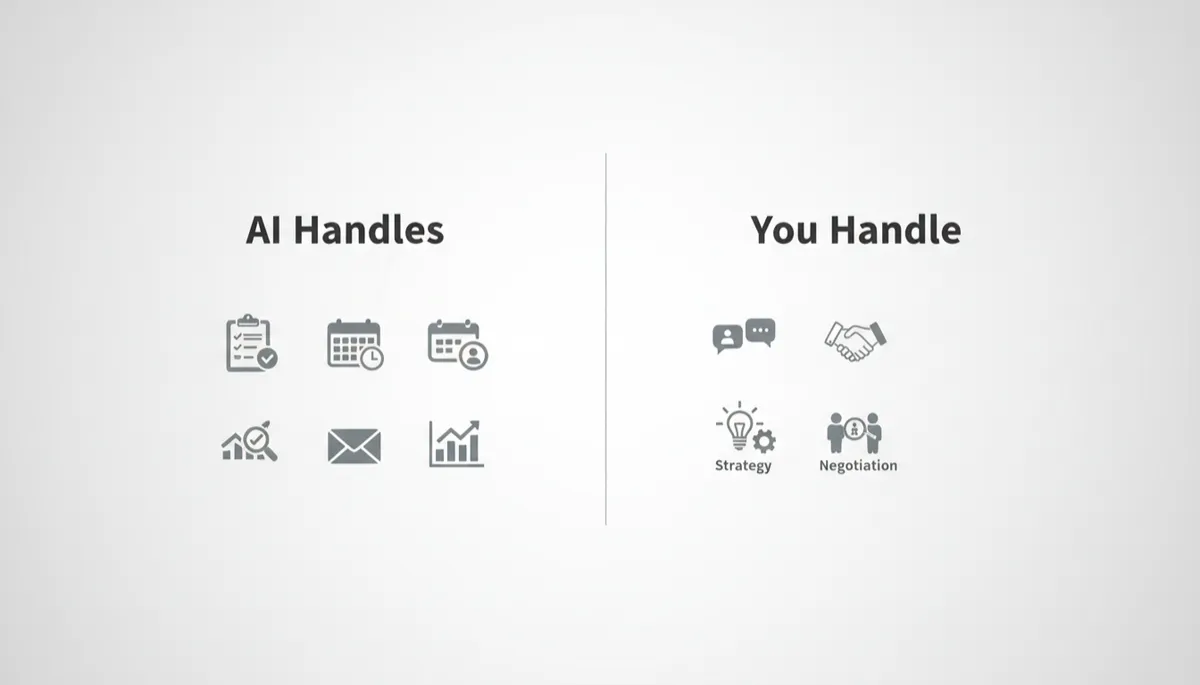
The winning strategy is to let AI own the admin while you own the relationship and judgment.
| AI Handles Reliably | You Handle Powerfully |
|---|---|
| Logging calls, emails, WhatsApp chats into CRM. | Running discovery conversations that uncover real pain and budget. |
| Drafting first-touch outreach and standard follow-up messages. | Adapting your pitch live based on what the customer actually says. |
| Scoring and segmenting leads based on behaviour and fit. | Choosing which accounts to prioritise this quarter and why. |
| Scheduling meetings, sending reminders, updating statuses. | Navigating multiple stakeholders and building consensus to close. |
| Answering routine FAQs and sharing standard documents. | Handling complex objections, pricing negotiations, and custom deals. |
In other words, AI handles the 70% admin so that you can spend 80% of your time actually selling, instead of the reverse. That is the real promise of AI and sales professionals working together — not replacement, but a flipped ratio of time and energy.
The Indian SMB Reality — What This Means for You as a Business Owner
For many Indian SMBs, there is no separate “CRM executive.” The CRM job is the business owner in Chennai, Coimbatore, or Kochi, juggling sales calls, supplier payments, GST filings, and family responsibilities — with a spreadsheet or basic CRM open in one tab and WhatsApp Web in another.
In this context, AI is not coming to replace you. It is coming to take over the 3–4 hours per day you currently spend on manual follow-ups, copy-pasting numbers into CRM, and chasing people for meeting confirmations. Those hours are exactly where you feel the most drained and least strategic — and exactly where AI is strongest.
Imagine your CRM automatically:
- Sending polite WhatsApp follow-ups to yesterday’s enquiries while you are on a factory visit.
- Booking appointments into your calendar without you touching your phone.
- Updating lead status and expected revenue after each interaction, so your pipeline is always current.
- Highlighting the five hot leads you should personally call before 5 p.m. today.
That is what an AI-first CRM like RevMax is designed to do — especially for Indian SMBs that live on WhatsApp and phone calls more than email. Instead of worrying, “will AI replace my CRM job?”, the more useful mindset is, “How do I make AI my junior assistant, so I can act like a CEO?”
Who Is Actually at Risk — And How to Not Be Them
We have to be direct here. Some roles are at risk from AI, especially in the “AI replacing sales jobs 2026” conversation. The ones in danger share a pattern: high volume, low judgment, low relationship depth.
- SDR roles that only send cold emails and cold WhatsApp messages from a script, with little adaptation or discovery.
- Telecalling teams measured only on number of dials, not on quality of conversations or outcomes.
- CRM admins whose full-time work is manual data entry and report creation, without analysis or recommendations.
These roles are being squeezed because AI can now do much of that work faster and cheaper. But that does not mean the people in those roles are doomed. It means the work they do must shift — from repetition to judgment, from scripts to relationships, from “type what the boss says” to “advise the boss on what the data means.”
Whether you are a business owner, a sales rep, or a CRM manager, the move is the same:
- Stop competing with AI on speed and volume. You will lose that race. Let AI take the repetitive tasks by design.
- Start competing on judgment, relationship, and expertise. These are the areas where human advantage grows as AI spreads.
- Learn to direct AI instead of ignoring it. The professionals who thrive will be the ones who can say, “Give me three options,” then choose and refine the best one.
This is exactly the kind of transition leaders like Avinash N U work on with Indian sales teams — shifting from manual, reactive selling to AI-augmented, consultative selling that protects careers while growing revenue. You can explore more strategic guidance at Revenue Mastery Consulting.
The 5 Skills That Become More Valuable as AI Takes Over
1. Consultative Selling
Consultative selling means you act like a doctor, not a shopkeeper. You diagnose before you prescribe. As AI automates product knowledge and feature lists, your value lies in understanding the customer’s real business problem and guiding them to the right solution — even if it is not the most expensive one you offer.
2. Relationship Depth
Relationship depth is more than saving birthdays in CRM. It is about knowing how your customer’s cash flow works, what their board is worried about, and how your product fits into their next 3–5 years. AI can remind you to call; only you can have the conversation that makes them say, “Let us stay with this partner; they understand us.”
3. AI Fluency
AI fluency does not mean becoming a programmer. It means knowing what to ask AI for, how to check its work, and where to apply it in your day. For example, using AI to summarise call notes, propose next steps, or generate three versions of a follow-up email that you then refine. The professionals who treat AI as a force multiplier, not a threat, will move faster than those who avoid it.
4. Strategic Thinking
As AI gives you more data and more suggestions, your job is to decide what not to do. Strategic thinking is about patterns, markets, and trade-offs. Should you focus on Chennai this quarter or expand to Coimbatore? Should you raise prices or add a lower-tier plan? AI can simulate scenarios, but you own the final decision and accountability.
5. Emotional Intelligence
Emotional intelligence is your ability to read the room — even when the “room” is a WhatsApp chat or a Zoom call. It is sensing when a prospect is overwhelmed, when a team member is burning out, or when a long-term client feels taken for granted. AI cannot yet pick up these signals with the same nuance, especially across languages and cultures. That makes EQ a premium skill in AI-heavy environments.
How Smart Businesses in India Are Using AI CRM Right Now
Across India, forward-thinking SMBs are already using AI CRM to change how they work — not by firing teams, but by reassigning human time to higher-value work. In many cases, they use tools like RevMax to automate the “invisible labour” that previously stole their evenings and weekends.
- A Chennai-based training company uses AI to send structured WhatsApp follow-ups after every enquiry, capture course interests, and book demo slots — while the founder focuses on delivering webinars and closing institutional deals.
- A regional SaaS provider lets AI score incoming leads and route only the best-fit prospects to senior reps, increasing close rates without adding headcount.
- A real estate brokerage automates appointment reminders and document-sharing on WhatsApp so agents can spend more time on site visits and negotiation, not on chasing confirmations.
In each case, AI is not the “hero.” The human still runs the business, owns the relationships, and makes the calls. AI simply ensures no lead is forgotten, no follow-up is delayed, and no data is lost. If you want to see how this looks in a WhatsApp-first workflow, explore RevMax WhatsApp Studio, where AI handles the busywork while you stay in control of every important conversation.
Frequently Asked Questions
Will AI completely replace salespeople?
Current evidence says no. Major reports like the World Economic Forum’s Future of Jobs 2025 and Salesforce’s State of Sales 2026 show that sales roles are growing overall, and that AI is mainly automating repetitive tasks, not full jobs. The professionals who focus on relationships, judgment, and consultative selling are seeing their careers strengthen — not disappear.
Which sales roles are most at risk from AI?
The roles most exposed are transactional, script-driven positions such as pure outbound SDRs, telecallers measured only by dials, and CRM admins who do manual data entry without analysis. These roles can be heavily automated. To reduce your risk, shift towards responsibilities that involve discovery, negotiation, account management, and strategy — the parts AI cannot do well.
What CRM tasks should I automate first?
Start with tasks that are repetitive, rule-based, and frequent. For most Indian SMBs, that means: automated WhatsApp follow-ups, meeting scheduling and reminders, lead capture from forms into CRM, call and chat logging, and basic lead scoring. Tools like RevMax are built specifically to automate these layers without forcing you to change your entire sales process overnight.
How do I become more valuable as AI takes over repetitive tasks?
Treat AI as a junior team member that handles low-level work so you can move up the value chain. Invest in skills like consultative selling, relationship depth, AI fluency, strategic thinking, and emotional intelligence. Use AI to prepare you better for every interaction — but make sure the customer remembers you, not the tool, as the person who understood and solved their problem.
Is AI in CRM a threat or an opportunity for Indian business owners?
It is both — depending on how you respond. If you ignore AI while your competitors use it to follow up faster, respond 24/7, and keep cleaner data, you will feel the threat. If you adopt AI early, especially for WhatsApp-based workflows and CRM automation, you gain a productivity and consistency edge that most small teams cannot match manually. In that sense, AI is a powerful opportunity for Indian SMBs to punch above their weight.
Closing: Ask a Better Question — And Take Back Control
When you strip away the hype, the question “will AI replace my CRM job?” is really about control. Do you feel like technology is happening to you, or are you using it deliberately to protect and grow your value?
The better question for 2026 is: “Am I spending most of my time on work that AI can do, or on work AI cannot do?” If your day is full of data entry, scripted follow-ups, and copy-paste tasks, then yes, you are vulnerable. If your day is full of discovery calls, negotiation, account strategy, and decision-making, AI becomes fuel — not a threat.
For Indian sales professionals and business owners, the opportunity is clear. Use AI to:
- Automate the 3–4 hours of manual CRM work that drains you daily.
- Ensure every lead is followed up, every meeting is confirmed, and every conversation is logged — without relying on memory.
- Free your calendar and your mind for the human work that actually wins deals and builds a reputation.
AI will not replace salespeople who close. It will replace salespeople who act like scripts. If you choose to move towards judgment, relationships, and strategy — and let AI handle the rest — you are on the right side of that line.
References & Links
- Salesforce, State of Sales 2026 — https://www.salesforce.com/resources/research-reports/state-of-sales/
- World Economic Forum, The Future of Jobs Report 2025 — https://www.weforum.org/publications/the-future-of-jobs-report-2025/
- PMC/NIH, AI in CRM Research — https://pmc.ncbi.nlm.nih.gov/articles/PMC11382090/
- ScienceDirect, AI and Sales Performance Study — https://www.sciencedirect.com/science/article/pii/S2444569X25000769