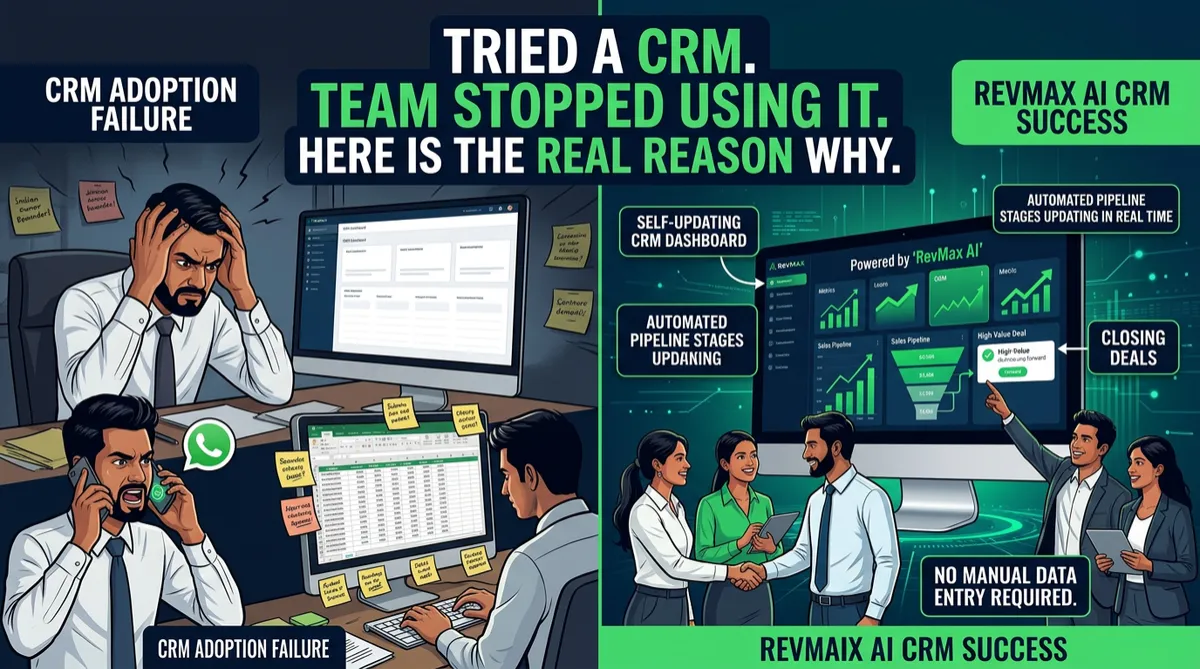
Tried a CRM and Your Team Stopped Using It? Here Is the Real Reason Why
You bought the CRM with genuine optimism. The demo was impressive. The vendor promised it would transform your sales process, give you complete pipeline visibility, and stop leads from falling through the cracks. You signed up, paid the subscription, spent three weeks getting it set up — and then watched your sales team quietly stop using it. Within 60 days, they were back on WhatsApp, back on Excel, back to the same chaos the CRM was supposed to fix.
If this is your experience, you are not alone. Every year, companies invest in CRM systems with high hopes. Six months later, the expensive system sits largely unused. Sales reps continue tracking deals in spreadsheets. Customer data remains scattered across email inboxes and personal notes. The promised transformation never materialises.
The good news: your team did not fail. Your CRM did not fail. The implementation model failed. And it fails in the same predictable way, for the same predictable reasons, across every Indian SMB that has tried it. This guide explains exactly what those reasons are — and what the fix looks like for Tamil Nadu businesses in 2026.
What Tamil Nadu Business Owners Are Saying About This Problem
"We paid for Zoho for 8 months. After month 2, only I was logging in — nobody else bothered."
"My sales team says they are updating the CRM but nothing is in there. I have no idea what is happening with our leads."
"We spent 3 weeks configuring the CRM and the first week of use, my team went back to WhatsApp. What did we do wrong?"
"The CRM shows 20 leads. My team says we have 80 active prospects. Where are the other 60?"
"I asked my salesman why he doesn’t update the CRM. He said it takes 10 minutes to log one visit. He visits 6 clients a day."
"We tried Freshsales, then Zoho, then HubSpot. None of them stuck. Is there something wrong with our team?"
There is nothing wrong with your team. The CRM became extra work instead of replacing existing work.
Section 1: The Uncomfortable Truth About CRM Failure in India
Direct Answer: CRM adoption fails in India not because the software is bad and not because the sales team is resistant to technology. It fails because the CRM was designed around an assumption that does not hold in the Indian SMB context — that salespeople will voluntarily add data entry to their already full workday, in exchange for benefits that flow primarily to management rather than to them.
Failure rates of 20 to 70 percent for CRM projects exist, primarily due to poor user adoption as the leading cause, lack of integration with other tools at 17 percent, and complexity of use at 7 percent.
Only 40 percent of businesses claim a 90 percent CRM adoption rate, while the majority struggle to encourage system adoption. A CRM that exists primarily to give management visibility, while asking the salesperson for data entry that serves someone else’s dashboard, is asking for a specific, ongoing personal cost in exchange for someone else’s benefit.
When your Chennai salesperson does not update the CRM, they are not being lazy. They are making a completely rational decision. If updating a deal takes longer than sending a WhatsApp message, WhatsApp wins. Every time.
Section 2: The 6 Real Reasons Your Team Stopped Using the CRM
Reason 1: The CRM Added Work Without Adding Value to the Person Doing the Work
Think about what you are asking a Tamil Nadu salesperson to do. After every WhatsApp conversation, they must open a separate application, find the lead record, update the stage, add call notes, set a follow-up task, and save. That process takes 5 to 10 minutes per interaction. A salesperson having 15 to 20 customer interactions per day is being asked to spend 2 to 3 additional hours every day on data entry. Nobody does this consistently. Not in Chennai. Not in Mumbai. Not anywhere.
Reason 2: The CRM Sat Alongside WhatsApp — It Did Not Replace It
CRM adoption usually fails when the system sits after the real workflow. Conversations happen in WhatsApp, decisions happen on calls, and the CRM becomes an administrative reconstruction. Leadership assumes the CRM replaced Excel. It did not. The CRM simply joined Excel. Eventually the team stops updating one of them. The CRM loses.
To understand why WhatsApp as the primary sales channel creates this structural problem, read our guide on why WhatsApp is not a CRM — and what the right combination looks like for Tamil Nadu businesses.
Reason 3: The System Was Too Complex for the Team That Had to Use It
Excessive customisation creates unnecessary complexity. Many organisations add too many fields and communication workflows. Small teams often struggle with advanced configurations meant for enterprise use. Instead of eliminating inefficiencies, the CRM recreates them in a more structured but equally painful way. Users get overwhelmed, and adoption drops.
Reason 4: Training Was a One-Time Event, Not an Ongoing System
Many companies conduct a one-day CRM training session and assume employees will figure out the rest. A few weeks later, usage declines because people forget processes or discover situations that were not covered. Lack of training leads to frustrated employees and lower support for the new tools. CRM adoption is a behavioural change, not a knowledge transfer.
Reason 5: The Data in the CRM Became Unreliable — So Nobody Trusted It
Imagine opening your CRM and finding duplicate customers, outdated contact details, and missing phone numbers. After a few experiences like that, your team stops trusting the system. The data quality problem and the adoption problem are circular: low adoption produces poor data, poor data produces distrust, distrust produces lower adoption. The only way to break the cycle is to remove the human dependency from data entry entirely.
Reason 6: Leadership Accepted Verbal Updates as a Parallel System
Adoption collapses when leadership accepts verbal updates as a parallel system. If your Monday morning pipeline review still happens via a WhatsApp group message asking everyone to share their numbers — your CRM has already lost. The team knows the CRM is not the real system of record. So they stop treating it like one.
Section 3: The Test That Reveals Whether Your CRM Problem Is Fixable
Before investing in a new CRM, ask one final question: if you removed the mandatory CRM update rule tomorrow, how many reps would still use it? Be honest. If the answer is very few, your problem is not discipline. It is product experience.
Then ask these five questions honestly:
| Question | What a Green Answer Looks Like |
|---|---|
| Does the CRM update itself automatically from any source? | Every interaction is logged without any manual step |
| Is WhatsApp integrated directly — not a separate tool? | Every WhatsApp message logs to the CRM record automatically |
| Does the CRM give the salesperson something useful back? | Full lead history and recommended next action before every call |
| Is the system sized for your actual team? | Key actions completable in under 30 seconds on a phone |
| Does it update as part of actions the team already takes? | Stage changes happen from system actions, not from team memory |
If you answered no to more than two of these questions, changing CRM platforms will not fix your adoption problem. Replacement is not justified merely because adoption is poor. If the underlying workflow remains unchanged, a new CRM reproduces the same failure with a different interface.
Section 4: The Real Fix — And Why It Is Not What Most People Think
Most Tamil Nadu founders who have experienced CRM failure assume the next step is either trying a different platform or doubling down on enforcement. Both are wrong.
The real fix has three parts:
Fix 1: Make the CRM Update Itself — Remove the Human Data Entry Requirement
Every lead that arrives — from WhatsApp, Facebook, Google, 99acres, JustDial, your website — should create a CRM record automatically. Every automated follow-up message should log itself automatically. Every appointment booked should update the pipeline stage automatically. When updating the CRM becomes effortless, adoption naturally improves — because there is nothing to adopt. The system maintains itself.
Fix 2: Make the CRM WhatsApp-Native — Not WhatsApp Adjacent
For Tamil Nadu sales teams, WhatsApp is the operating environment. Any CRM that treats WhatsApp as an integration rather than the foundation is asking the team to split attention between two systems. The right system is one where WhatsApp and CRM are the same thing — where every WhatsApp conversation is automatically logged and every follow-up flows through WhatsApp without any manual triggering.
Fix 3: Size the System for Your Team — Not for an Enterprise
A Tamil Nadu real estate developer with 5 salespeople needs: lead source, configuration, budget, timeline, follow-up stage, and next action. That is 6 fields. Not 18 modules. The most effective CRM for your team is the simplest one that captures the data that actually changes a sales decision.
Section 5: What CRM Adoption Looks Like When Done Right
RevMax AI was built specifically to solve the CRM adoption problem for Tamil Nadu SMBs — by removing the human data entry requirement from the system architecture entirely.
A new lead arrives from 99acres at 7:30 PM on a Friday.
The system creates a CRM record automatically — source tagged, timestamp recorded, lead details populated. No human involvement.
The AI sends a personalised WhatsApp message in under 60 seconds.
The message and the lead’s response are both logged automatically against the CRM record. No manual entry.
The AI asks 2 to 3 qualifying questions. The lead responds.
Qualification answers are scored and recorded. The lead is marked as hot, warm, or cold. Pipeline stage updates. No human involvement.
The hot lead is escalated to the salesperson with a CRM summary.
The salesperson sees: lead name, source, enquiry details, qualification answers, lead score, and recommended next action. They make one call — to a pre-qualified, pre-informed prospect — and log the outcome in 30 seconds because the rest of the record was already complete.
Management sees the complete pipeline in real time.
Not because the sales team updated it manually. Because the system updated it automatically as a by-product of doing its job.
This is what a well-executed implementation delivering 200 to 400 percent ROI within 8 to 12 months actually looks like. The adoption is automatic. The team does not have to change how they work — the system works around them.
Section 6: Why Tamil Nadu Businesses Choose RevMax AI After a Failed CRM Experience
RevMax AI was built by Avinash N U, Founder and Chief Strategist at Revenue Mastery Consulting — specifically for Tamil Nadu SMBs who have been through the CRM adoption cycle and come out the other side with an expensive subscription and no change in their revenue system.
✅ The CRM updates itself — every lead creates a record automatically, every interaction logs itself, every pipeline stage updates automatically — no manual entry required
✅ WhatsApp is the foundation, not an add-on — built on the official WhatsApp Business API, natively WhatsApp-first
✅ Sized for Tamil Nadu SMBs — not an enterprise platform with 18 modules, done-for-you in 48 to 72 hours
✅ The team gets something back — automatic lead routing, pre-qualified conversations, full context before every call
✅ Adoption is not a concern — the pipeline is always accurate because it was never dependent on human discipline
✅ Already the #1 AI CRM in Tamil Nadu — recognised, trusted, deployed by Tamil Nadu businesses
The Diagnostic Checklist — Run This Before Buying Another CRM
| Question | What a Green Answer Looks Like |
|---|---|
| Does the system update automatically from WhatsApp? | Every WhatsApp message logged without any manual step |
| Does it capture leads from all channels automatically? | Every portal, ad, form, and missed call creates a record in real time |
| Does it give the salesperson something useful before a call? | Full lead history, qualification score, recommended next action |
| Does it respond to leads automatically when team is unavailable? | AI responds in under 60 seconds at any hour from any channel |
| Can the team use it on mobile without friction? | All key actions completable in under 30 seconds on a phone |
| Does it update the pipeline automatically as leads progress? | Stage changes happen from system actions, not from team memory |
Frequently Asked Questions
Why does my sales team not use the CRM even after training?
The sales team’s disengagement is a rational response to a system that made their job harder without giving them anything back. No amount of training changes that underlying trade. The fix is redesigning the system so it updates itself from actions the team is already taking — removing the manual entry burden entirely.
Should I switch to a different CRM platform after adoption failure?
Nearly every CRM on the market will work if the field list is short and the system returns something useful. Changing platforms without changing the design reproduces the same result at a new price. Diagnose whether the problem is the platform or the implementation model. In most Tamil Nadu SMB cases, the problem is the manual data entry requirement — which switching platforms does not fix.
Is the CRM adoption problem specific to Indian sales teams?
No — it is a global phenomenon. But it is amplified in India because Indian sales teams are WhatsApp-first, phone-first, and field-first. Any CRM that does not integrate natively with WhatsApp and does not update automatically from mobile interactions asks the Indian sales team to split their workflow in a way that creates more friction than Western desktop-first teams face.
What is the fastest way to fix CRM adoption for my Tamil Nadu business?
Stop asking your team to update the CRM manually. Deploy a system that updates itself automatically from every lead interaction, every follow-up message, every appointment booking, and every pipeline stage transition. When data entry is not a human task, adoption is not a concern. The pipeline is always accurate because it was never dependent on human discipline.
How do I know if my business needs a CRM or an AI automation system?
If your primary problem is pipeline visibility — you need a CRM. If your primary problem is lead response speed and follow-up consistency — you need AI automation. If both problems exist, you need a system that integrates both into a single architecture where AI automation automatically maintains the CRM as a by-product of doing its job. That model eliminates the adoption problem entirely.
How long does it take to get a Tamil Nadu sales team using a new system?
With a traditional CRM requiring manual data entry, expect 4 to 8 weeks for initial adoption and 3 to 6 months before the system is reliably maintained. With an AI-powered system that updates itself automatically, the team is productive from day one — because the system does not require behavioural change. It works around existing behaviour rather than demanding new behaviour.
Your Team Is Not the Problem. The System Is. Here Is How to Build One That Actually Works.
If you have watched your team stop using a CRM and concluded that the problem is discipline or attitude — this guide has shown you that the diagnosis is wrong. Your team’s behaviour was rational. The system asked more of them than it gave back.
One consultation shows you exactly what a system looks like where adoption is not a concern — because the system does not depend on your team remembering to use it.
📞 Book a Free AI Automation Consultation → 🚀 Try RevMax AI Free →

