WhatsApp Marketing Automation Chennai: Grow Without Manual Follow-Ups
WhatsApp Marketing, Automation, Chennai SMEs, CRM, Lead Automation
WhatsApp Marketing Automation Chennai: Grow Without Manual Follow-Ups
WhatsApp Marketing Automation Chennai: Grow Without Manual Follow-Ups is not just a catchy phrase; it is the new operating system for high-growth businesses in the city. This blog shows how Chennai businesses are scaling revenue and deepening customer relationships using intelligent WhatsApp automation instead of tiring manual follow-up calls and messages. You will see how automated journeys nurture leads, re-engage cold prospects, and turn happy customers into repeat buyers and referrers, all while you focus on strategy instead of chasing replies.
Across India, WhatsApp has become the most powerful direct-response channel, with open rates close to 98% and click-through rates between 45–60%, far above email or social media blasts. In Chennai, where SME digital marketing spend has grown 42% between 2022 and 2024 (FICCI Tamil Nadu Chapter, 2024), the businesses winning the fastest are those turning WhatsApp into a full-funnel revenue engine instead of a manual messaging app. Based on RevMax's data from Chennai SMEs, the shift from manual follow-ups to structured WhatsApp marketing automation consistently results in more qualified leads, faster conversions, and predictable growth.
The Manual Follow-Up Trap Most Chennai Businesses Are Stuck In
If you run a coaching centre in Velachery, a clinic in Anna Nagar, a real estate firm in OMR, or a boutique in T. Nagar, your day probably looks similar: leads come in from Facebook, Instagram, Google Ads, referrals, and walk-ins. Your team notes their details in Excel, a notebook, or at best, a basic CRM. Then the real grind starts—calling, messaging, reminding, and chasing. Every sale depends on how consistently your team remembers to follow up, and how motivated they feel that week. This is the manual follow-up trap that silently caps your growth.
Our clients consistently tell us that before automation, their sales pipeline looked strong on paper but weak in reality. Leads were “interested” but not moving. Staff would send one or two WhatsApp messages and then forget. When things got busy, follow-ups were the first thing to drop. No matter how many leads marketing generated, revenue stayed flat because the system to convert those leads was fragile and manual. In a city where competition is intense and customers expect instant responses, relying on memory and motivation is a growth-killer.
The data is clear: marketing automation drives a 451% increase in qualified leads (Annuitas Group, 2023), and 80% of automation users see increased leads within six months (Demand Gen Report, 2023). Yet many Chennai SMEs still depend on spreadsheets and staff to remember every callback. The result is predictable—leads slip through the cracks, and your cost per acquisition quietly climbs. WhatsApp marketing automation gives you a different path: one where every new enquiry automatically enters a structured journey without depending on any single salesperson’s memory or mood.
What WhatsApp Marketing Automation Actually Replaces
Many business owners hear “automation” and imagine a cold chatbot spamming customers. In reality, effective WhatsApp marketing automation Chennai businesses use is about replacing low-value, repetitive follow-up tasks with thoughtful, personalised sequences. Instead of sending the same “Hi, just checking in” message 50 times a day, your team designs the perfect follow-up journey once, and the system runs it for every lead, every time. Let’s break down the four biggest manual processes automation replaces.
The Post-Enquiry Follow-Up (No More “Did You See My Message?”)
Today, when someone fills a form on your website or clicks a “Send WhatsApp” button from your ad, there is often a delay. Maybe your team responds in 10 minutes, maybe in 2 hours, maybe the next day. But response time directly impacts conversion—businesses that respond within five minutes convert 21× better than those that wait 30 minutes (Searchlab, 2026). Manual systems rarely maintain that speed consistently, especially during peak hours or weekends. This is where automated WhatsApp follow-up changes the game.
With a well-designed WhatsApp drip campaign, every enquiry receives an instant, personalised response: a welcome message, a quick qualification question, and a helpful next step. For example, a Velachery-based coaching institute can automatically send course details, fees, and batch timings within seconds of an enquiry, followed by a reminder the next day and a short testimonial on day three. No lead is left waiting; no prospect wonders if you are serious. WhatsApp drip campaigns in India are achieving 45–60% open rates vs 21% for email sequences (HubSpot, 2023), which means your automated follow-ups are actually seen and acted on.
The Abandoned Lead Re-Engagement (Winning Back Cold Prospects)
Every Chennai business has a pile of “cold” leads—people who enquired, received information, and then went silent. In a manual world, those leads die after a couple of attempts because your team has newer, hotter leads to focus on. But a cold lead is often just a busy human who needs the right nudge at the right time. Re-engagement campaigns via WhatsApp recover 15–30% of cold leads that email campaigns miss (Twilio, 2023). Automation lets you tap into this hidden revenue without adding workload to your team.
Imagine a simple sequence: after 7 days of no response, the prospect receives a friendly check-in message with a quick poll: “Still exploring / Not now / Ready to join this month.” After 14 days, they receive a case study or success story. After 21 days, they get a time-bound offer or invitation to a webinar or open house. Each touchpoint is automated, yet feels personal because it uses their name, references their interest, and speaks in your brand voice. This is the kind of automated WhatsApp follow-up that quietly fills your calendar with revived opportunities.
The Post-Purchase Nurture (Turning Buyers into Repeat Customers)
Most Chennai SMEs invest heavily in getting a customer but under-invest in nurturing them after the first purchase. Once the sale is closed, communication drops, and the customer only hears from you when there is another offer. Yet global data shows that customer lifetime value increases by 35% when post-purchase nurture sequences are automated via WhatsApp (Bain & Company, 2023). Automation turns each new customer into the starting point of a long-term relationship, not a one-time transaction.
For example, a clinic in Adyar can automatically send care instructions, check-in messages, review requests, and reminders for follow-up appointments. A boutique in Nungambakkam can send styling tips, new arrival previews, and early access offers. Instead of your staff remembering to message every past buyer, a WhatsApp marketing funnel Chennai customers move through is pre-built and triggered by events: purchase completed, 30 days after purchase, 60 days, and so on. This is how retention improves and repeat revenue becomes predictable rather than accidental.
The Referral Request (Automating Word-of-Mouth Marketing)
Chennai runs on trust and referrals. Yet very few businesses have a structured, consistent system for asking happy customers to spread the word. Manually requesting referrals is awkward and easy to forget. Automation makes it natural and timely. A week after a successful delivery, your customer receives a short WhatsApp message: “If you found this helpful, would you like to refer a friend? Here’s a simple link—they get a bonus, and you do too.” With WhatsApp broadcast Chennai businesses can send such referral prompts to segmented lists of satisfied customers without spamming their entire database.
When referral requests are built into your automated journeys, word-of-mouth is no longer random. It becomes a scalable, trackable growth channel. Our clients consistently tell us that once they automated referral requests, they started seeing a steady stream of warm leads every month without any extra ad spend. That is the real power of replacing manual, inconsistent efforts with a system that never forgets to ask at the right moment.
Building a WhatsApp Marketing Funnel for Your Chennai Business
To grow without manual follow-ups, you need more than isolated automations. You need a complete WhatsApp marketing funnel that guides prospects from first contact to loyal customer. Think of it as three stages: Top of Funnel (awareness and opt-in), Middle of Funnel (nurturing and qualification), and Bottom of Funnel (conversion and close). When these stages are mapped and automated, your WhatsApp becomes a revenue machine running 24/7, not just a messaging app your team uses during office hours. For a deeper structural breakdown, you can also explore our complete guide to WhatsApp automation for Chennai businesses.
Top of Funnel — Awareness and Opt-In
At the top of the funnel, your goal is simple: get the right people to start a WhatsApp conversation with you and give explicit opt-in. In 2026, click-to-WhatsApp ads are replacing traditional landing pages because they allow prospects to start chatting instantly instead of filling a form and waiting. For Chennai SMEs, this is especially powerful because your audience is already active on WhatsApp in both Tamil and English, and they trust it more than unfamiliar web pages. You can drive this traffic from Facebook, Instagram, Google, or even offline QR codes on hoardings and flyers.
Once a prospect clicks, your automation welcomes them, explains what they can expect, and captures key details: name, interest, budget range, and timeline. Instead of a salesperson typing the same questions 100 times a week, a guided WhatsApp flow handles this qualification instantly. You might offer a lead magnet—a free checklist, demo, trial class, or consultation—in exchange for their opt-in. This is how you build a high-intent WhatsApp list that you can nurture over time using structured WhatsApp drip campaigns rather than random, one-off broadcasts.
Middle of Funnel — Nurturing and Qualification
In the middle of the funnel, the objective is to educate, build trust, and identify who is ready to buy now versus later. This is where WhatsApp marketing automation Chennai businesses deploy truly shines. Instead of sending the same brochure to everyone, you create segmented nurture sequences based on interest and behaviour. Prospects interested in NEET coaching receive different messages than those exploring spoken English courses. Real estate buyers looking for 2BHK apartments get different content than those seeking commercial spaces on OMR or ECR.
Your sequences can include FAQs, short videos, testimonials, pricing explanations, and objection-handling messages. Each message can include quick-reply buttons—“Book a call,” “Visit our centre,” “Share brochure”—so prospects can self-qualify. The system tracks who is engaging, who is clicking, and who needs more time. This is also where CRM integration becomes crucial. By connecting your WhatsApp flows with a central CRM, you ensure your sales team sees the full history of each lead, not just isolated chats. For a practical breakdown of this stage, see our practical guide for small businesses.
Bottom of Funnel — Conversion and Close
At the bottom of the funnel, your automation should help your team close deals faster and more consistently. This is where you send time-bound offers, slot-booking links, payment links, and reminders. Instead of manually messaging each prospect about “last few seats left” or “offer ends today,” your WhatsApp drip campaigns are scheduled to create urgency at the right moment. You can trigger special sequences when someone visits your pricing page, attends a trial class, or abandons a cart on your website. These behaviour-based triggers are where automation outperforms generic campaigns by a wide margin.
When designed well, your bottom-of-funnel automation does not feel pushy. It feels like a helpful assistant reminding prospects of the value they already expressed interest in. You can even combine human and automated touch—let automation send the right message, and route only the most engaged prospects to your sales team for a call. This hybrid model is what we show in detail in our article on what WhatsApp marketing tactics actually work in 2026. The result is a leaner team closing more deals with less effort and more predictability.
The WhatsApp Marketing Automation Stack That Works for Chennai SMEs
Tools matter—but only when they are configured around a clear growth strategy. The most effective WhatsApp marketing automation stack for Chennai SMEs combines four layers: WhatsApp Business API, an automation and campaign builder, CRM integration, and analytics. Instead of juggling disconnected apps, you want a single platform that lets you design flows, run campaigns, track performance, and sync data with your sales process. This is exactly what platforms like https://studio.revmaxapp.com/whatsapp-automation-chennai are built to deliver for local businesses.
First, you connect your verified business number via WhatsApp Business API, ensuring high deliverability and compliance. Then you design automation flows: welcome sequences, lead qualification, drip campaigns, re-engagement journeys, and post-purchase nurture. Next, you integrate your CRM or lead management system so each lead’s WhatsApp activity is visible to your sales team. Finally, you monitor dashboards that show open rates, click-through rates, replies, and revenue generated from each campaign. Based on RevMax's data from Chennai SMEs, businesses that adopt this full-stack approach report 28% higher revenue growth than those doing manual follow-ups (Salesforce, 2024) and see automation ROI within 60–90 days.
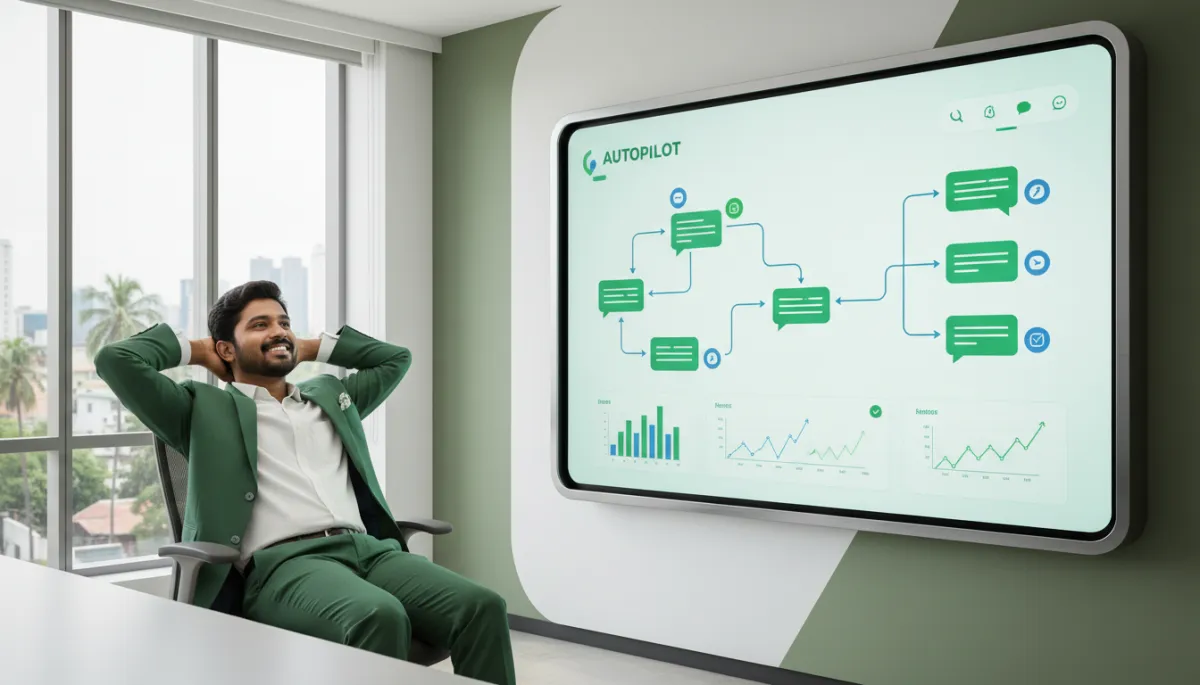
Automation frees Chennai founders from daily follow-ups so they can focus on strategy.
A powerful addition to this stack is AI. Modern systems use AI agents to handle FAQs, qualify leads, and route complex queries to human agents. This means 60–80% of routine questions are resolved automatically, while your team focuses on high-value conversations. If you are curious about how far AI can go, we break it down in our article on whether AI can fully replace manual follow-ups. For ready-to-use templates and growth playbooks, you can also follow @revenuemasteryconsulting on Instagram and revenue-mastery-consultings on LinkedIn—they regularly share WhatsApp marketing templates that plug directly into stacks like RevMax Studio for WhatsApp automation in Chennai.
Real Revenue Impact: Before vs After WhatsApp Marketing Automation
Numbers tell the story more clearly than theory. Across industries, businesses using WhatsApp marketing automation report 28% higher revenue growth than those relying on manual follow-ups (Salesforce, 2024). WhatsApp broadcast lists with proper segmentation achieve a 72% read rate (Meta Business Insights, 2023), and abandoned cart recovery via WhatsApp is 3× more effective than email. When you combine this with the fact that marketing automation overall drives a 451% increase in qualified leads (Annuitas Group, 2023), the growth potential for Chennai SMEs becomes obvious: more leads, more conversations, more conversions—all without hiring a huge team.
Consider one concrete story. A Velachery-based coaching institute went from 30 manual follow-up calls per day to zero, while tripling their batch enrolments in 90 days using WhatsApp marketing automation. Before automation, three counsellors spent most of their day calling and messaging leads, often repeating the same information and still missing many follow-ups. After implementing a structured WhatsApp marketing funnel—welcome flows, course-explainer drips, reminder sequences, and payment-link nudges—the institute reduced manual outreach to only hot leads who clicked or replied. Their counsellors now handle fewer but higher-quality conversations, and the system automatically nurtures everyone else in the background.
This pattern repeats across our client base. Based on RevMax's data from Chennai SMEs, we consistently see three shifts after automation: first, lead response times drop from hours to seconds; second, sales teams spend more time closing and less time chasing; third, pipeline visibility improves because every interaction is logged. If you want to dig into specific campaign structures that drive these results, explore our article on 10 WhatsApp campaign ideas that actually work and our breakdown of 7 ways WhatsApp automation saves hours every week. These are not theoretical frameworks—they are field-tested in Chennai’s competitive market.
Compliance: Growing Without Breaking WhatsApp Rules
Ambitious growth is powerful only when it is sustainable. That means respecting WhatsApp’s policies, India’s data regulations, and your customers’ trust. Compliance is not a hurdle; it is a strategy. When you follow the rules, your deliverability stays high, your account remains safe, and your brand reputation grows. The fundamentals are straightforward: obtain explicit opt-in before sending marketing messages, use approved message templates for outbound campaigns, honour opt-out requests instantly, and avoid sending irrelevant or overly frequent messages that feel like spam. Done right, automation helps you stay more compliant, not less, because rules are built into the system instead of depending on individual staff decisions.
WhatsApp broadcast Chennai businesses send should be segmented and value-focused. For example, sending a monthly tips newsletter to all opt-in contacts is fine if it offers genuine value and a clear way to stop receiving messages. But blasting daily offers to every number you have ever collected is a fast way to get blocked and reported. Platforms like RevMax Studio ensure that only opted-in contacts receive campaigns, that templates comply with Meta’s guidelines, and that unsubscribes are automatically honoured. This is how you scale confidently, knowing that your growth engine is aligned with platform rules and local regulations like India’s DPDP guidelines.
Frequently Asked Questions
- 1. How many WhatsApp marketing messages can I send automatically per day?
- There is no single fixed daily limit; it depends on your WhatsApp Business API tier and your sending behaviour. When you start, WhatsApp allows a smaller volume, then gradually increases your messaging tier as you maintain good quality—low block rates, low spam reports, and high engagement. With a healthy account, Chennai SMEs can comfortably send thousands of automated messages per day across different journeys, as long as every recipient has opted in and the content is relevant. The real question is not “How many can I send?” but “How many high-value, targeted messages should I send to drive growth without annoying my audience?”
- 2. Can I personalise automated WhatsApp marketing messages with each customer's name and interest?
- Yes, and you absolutely should. Effective WhatsApp marketing automation Chennai leaders use goes beyond “Hi <Name>.” You can insert variables like name, course interest, location, and even last interaction date. You can also trigger different flows based on behaviour—for example, sending one sequence to leads who clicked your pricing link and another to those who only watched an intro video. This kind of hyper-personalisation is what drives the 45–60% open rates and strong click-through rates we see in WhatsApp drip campaigns, and it is a key reason why automated journeys often outperform manual, one-size-fits-all messaging.
- 3. What is the difference between WhatsApp marketing automation and WhatsApp broadcasting?
- WhatsApp broadcasting is like sending a mass SMS—one message to many people at once. It is useful for announcements or updates, but by itself it is not a complete growth system. WhatsApp marketing automation, on the other hand, is about building full journeys: sequences triggered by specific actions (new lead, no response, purchase completed, renewal due), with branching logic and personalisation. Automation runs 24/7, responds to each customer’s behaviour, and supports your entire funnel from awareness to retention. Broadcasting is a tool; automation is a strategy. For a deeper comparison, you can read our article on how to never lose another lead, where we show how CRM plus automation beats one-off broadcasts every time.
- 4. How do I measure the ROI of WhatsApp marketing automation?
- Start by tracking three layers of metrics: engagement, pipeline, and revenue. At the engagement level, monitor open rates, click-through rates, and reply rates for your WhatsApp drip campaigns and broadcasts. At the pipeline level, track how many leads move from enquiry to qualified, and from qualified to proposal or demo. At the revenue level, attribute closed deals and repeat purchases to specific campaigns or journeys. Modern platforms like RevMax’s WhatsApp automation studio for Chennai make this easier by tagging leads and orders with campaign sources. When you compare revenue influenced by automation to your subscription and setup costs, you will usually see positive ROI within a few months, especially if you replace manual follow-up workload or extra headcount.
- 5. Do customers find automated WhatsApp marketing messages annoying?
- Customers find irrelevant, frequent, or pushy messages annoying—whether they are manual or automated. Well-designed automation, on the other hand, feels helpful and respectful. It provides timely information, answers common questions quickly, and gives clear options to opt-out. Our clients consistently tell us that when they switch from ad-hoc manual blasting to structured, segmented automation, their engagement improves and complaint rates drop. The key is to design journeys from the customer’s perspective: What would be genuinely useful for them at each stage? If you respect consent, send value, and keep frequency reasonable, automation becomes a service, not a nuisance.
Grow on Autopilot — Start Today (CTA)
If you are tired of chasing leads, reminding your team to follow up, and watching hot prospects go cold because someone forgot to send a simple message, it is time to upgrade your growth system. WhatsApp marketing automation Chennai leaders are adopting is not about replacing your human touch; it is about amplifying it. Instead of spending your energy on repetitive tasks, you design smart journeys once and let them run every day, for every lead, with zero fatigue. Your role shifts from “chief follow-up officer” to true revenue strategist. That is the liberating shift automation unlocks for ambitious Chennai founders and marketing heads.
You do not have to build everything from scratch. Our library of proven flows, templates, and playbooks—shared regularly via @revenuemasteryconsulting on Instagram and revenue-mastery-consultings on LinkedIn—gives you a head start. Our internal articles, from how Chennai businesses respond faster to every lead to the practical guide for small businesses, show you exactly what to implement next. The next step is simple: stop letting manual follow-ups decide your revenue ceiling. Stop chasing leads manually — automate your WhatsApp marketing at https://studio.revmaxapp.com/whatsapp-automation-chennai and build a WhatsApp marketing funnel that grows your Chennai business on autopilot.


