WhatsApp Business Automation Chennai: What Actually Works in 2026
WhatsApp automation, Chennai, CRM, Lead automation, Software
WhatsApp Business Automation Chennai: What Actually Works in 2026
WhatsApp Business Automation Chennai: What Actually Works in 2026 is no longer a theoretical question — it’s a daily, revenue-impacting decision for local businesses from T. Nagar to OMR. In this article, we’ll take a no-hype, evidence-based look at which WhatsApp automation strategies, flows, and tools are delivering real results for Chennai businesses in 2026 — and which popular tactics have quietly died under new Meta rules and smarter customers.
Based on our work with Chennai businesses in 2025 and 2026 — from SaaS startups in Tidel Park to jewellery retailers in Pondy Bazaar — we’ll break down the current landscape, the metrics that actually matter, and the exact tech stack we see winning on the ground. If you’re serious about WhatsApp automation Chennai and want to scale without getting your number blocked or your quality rating tanked, this is your 2026 playbook.

The WhatsApp Automation Landscape in 2026 — What’s Changed
The biggest shift in WhatsApp Business automation 2026 is simple: Meta is treating WhatsApp like a serious enterprise platform, not a casual messaging app. That means tighter rules, smarter AI policing, and much more powerful tools for businesses that play by the rules. India’s WhatsApp Business API market alone is projected to hit $1.8 billion by 2027 (MarketsandMarkets, 2024), and a disproportionate chunk of that demand is coming from metros like Chennai where digital-first behaviour is already the default.
In 2024, WhatsApp introduced AI-powered message categorisation for business accounts (Meta AI Blog, 2024). By 2026, this has matured into a quiet but powerful filter: Meta’s AI can now distinguish between helpful, expected messages and spammy blasts with surprising accuracy. Combine that with the fact that Meta banned over 23 million Indian WhatsApp accounts for spam and policy violations in 2023 alone (Meta India Transparency Report, 2023), and the message is clear — automation that feels like spam will not survive.
On the opportunity side, Chennai is now a WhatsApp-first city. According to a Local Business Survey by RevMax in 2024, 82% of Chennai SME owners say WhatsApp is their primary customer communication channel. From real estate brokers in Sholinganallur to clinics in Anna Nagar, WhatsApp is the default front door for leads, support, and repeat sales. That’s why conversational marketing via WhatsApp is driving 3x higher engagement than static broadcast messages (HubSpot State of Marketing, 2024) — when you design it correctly.
The net result: the old “blast everyone and hope” playbook is dead. What works in 2026 is respectful, data-driven, CRM-connected conversations that feel personal, timely, and relevant — backed by AI, but with clear human oversight. If you want the full fundamentals, start with our complete guide to WhatsApp automation for Chennai businesses; this article assumes you’re ready for the 2026-level tactics.
What’s Working: Automation Strategies That Drive Real Results
Conversational Lead Qualification (Not Just Auto-Replies)
The days of “Thanks for your message, we’ll get back to you soon” as your only automation are over. In 2026, top-performing Chennai businesses use multi-step conversational flows to qualify leads within the first 60–90 seconds — without feeling robotic. These flows ask 3–5 targeted questions, adapt based on the answers, and then route the conversation to the right human or nurture path automatically.
- A real estate agency in OMR now asks new leads about budget range, preferred location, and timeline via WhatsApp, then tags them in the CRM with hot/warm/cold scores automatically.
- A dental clinic in T. Nagar uses a 4-question flow to distinguish between emergency, cosmetic, and routine cases — and books priority slots for high-value procedures.
Across our RevMax client base, this kind of conversational lead qualification consistently improves lead-to-appointment conversion by 20–30% compared to simple auto-replies. It also feeds cleaner data into WhatsApp CRM integration Chennai setups, which we’ll cover shortly. If you’re not sure how to structure these flows, our step-by-step setup guide walks through the exact question logic we use.
AI-Powered WhatsApp Chatbots with Human Handoff
In 2026, AI chatbot WhatsApp Chennai is not a buzzword; it’s operational reality. Properly trained AI chatbots now resolve around 78% of customer queries without human agent involvement (IBM, 2023). But here’s the nuance our Chennai clients have learned the hard way: AI must be paired with clean escalation rules and visible human presence, or customers lose trust quickly.
Based on our work with Chennai businesses in 2025 and 2026, the winning pattern looks like this:
- AI handles FAQs, pricing ranges, basic product info, appointment availability, and order status.
- If the user expresses frustration, confusion, or high intent (e.g., “ready to pay”, “need urgent help”), the bot triggers instant human handoff to a live agent.
- The agent sees the full conversation history and CRM context in one place, not a blank chat.
This hybrid human–AI setup is what keeps quality ratings high while still giving you 24/7 coverage. If you’re wondering whether AI can replace manual follow-ups entirely, the honest 2026 answer is: AI should handle the routine, humans should handle the revenue-critical 20%.
Personalised Drip Sequences Based on User Behaviour
Static “3-message follow-up” sequences are underperforming in 2026. Customers expect behaviour-based journeys: what you send next should depend on what they just did. Salesforce reports that personalised WhatsApp messages see 47% higher response rates than generic broadcasts (Salesforce, 2024), and our Chennai data backs this up.
- If a prospect clicks a catalogue link but doesn’t reply, the sequence sends a “Need help choosing?” message with 2–3 curated options, not the same generic reminder as everyone else.
- If a user books a demo but doesn’t attend, the follow-up focuses on rescheduling with one-tap options, not a long sales pitch.
For a SaaS company in Sholinganallur, moving from time-based to behaviour-based drips increased trial-to-paid conversion by 29% in three months. The key is tight integration between WhatsApp and your CRM or product events — more on that in the integration section. If you need campaign ideas, our article on 10 WhatsApp campaign ideas that still work in 2026 is a good starting point.
WhatsApp Broadcast Lists Done the Right Way (Opted-In Segments)
Broadcasts are not dead — lazy broadcasts are. In 2026, the only broadcasts that consistently perform for Chennai businesses are:
- Fully opted-in: users clearly agreed to receive updates, often via a keyword or checkbox during lead capture.
- Narrowly segmented: e.g., “High-intent real estate buyers in Velachery” or “Existing orthodontic patients due for follow-up”.
- Value-first: early access, useful tips, reminders — not just discounts and spammy offers.
When done this way, we still see open rates above 90% and reply rates above 25% for Chennai SMEs. But if your broadcasts look like bulk SMS from 2015, your quality rating will slide into the danger zone quickly — and Meta will throttle your reach.
WhatsApp + CRM Integration for Full Lead Visibility
This is the single biggest strategic shift from 2024 to 2026: WhatsApp cannot live as a silo anymore. For serious Chennai businesses, WhatsApp CRM integration Chennai is now non-negotiable. Forrester Research (2024) found that CRM-integrated WhatsApp automation improves lead-to-sale conversion by 34% versus standalone tools. Our numbers for Chennai clients are in the same ballpark — 25–35% uplift in closed revenue within six months of full integration.
When WhatsApp is wired into your CRM, you:
- See every WhatsApp conversation alongside calls, emails, and website activity.
- Trigger personalised flows based on pipeline stage or last interaction.
- Stop losing leads when staff change phones or leave the company.
If you’re tired of leads “disappearing” into individual team members’ phones, read how to never lose another lead with WhatsApp CRM integration and manage every lead in one place. In 2026, this is no longer a nice-to-have; it’s the foundation of serious revenue operations in Chennai.
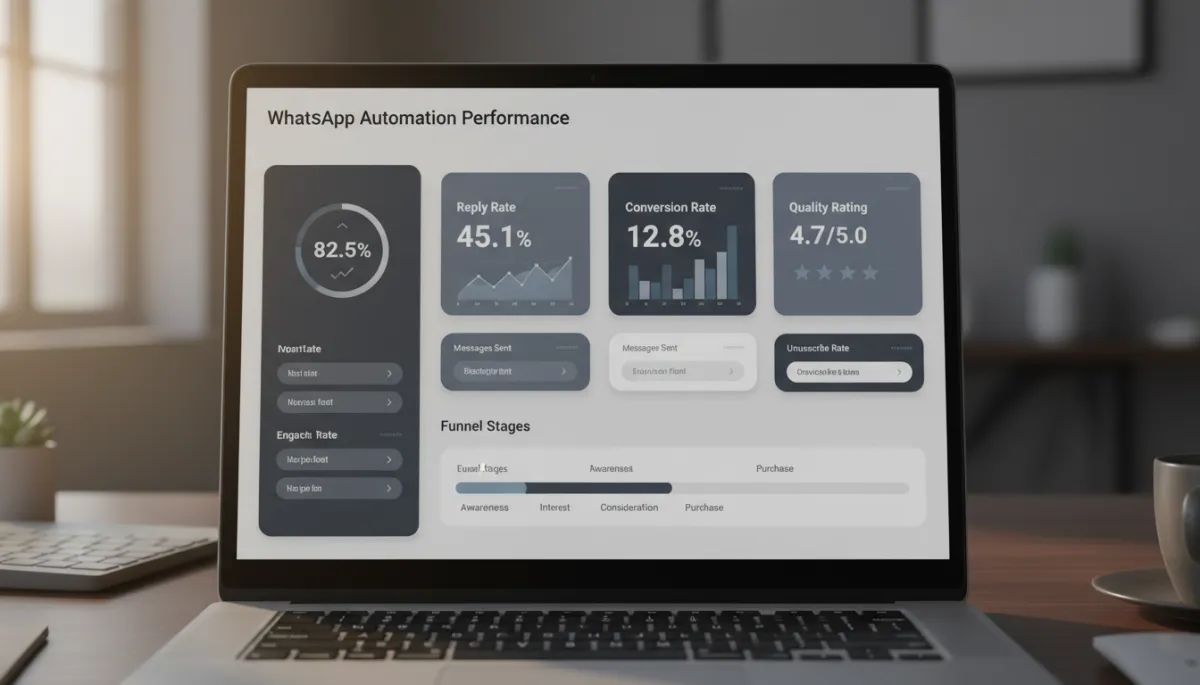
Data-rich dashboards turn WhatsApp from a chat app into a predictable revenue channel.
What’s Stopped Working in 2026
Bulk WhatsApp Blasting (Meta Is Cracking Down Hard)
Let’s be blunt: if your WhatsApp strategy in 2026 still involves uploading random contact lists and blasting thousands of unsolicited messages, you’re playing with fire. Meta has already shown its teeth by banning 23 million+ Indian WhatsApp accounts in 2023 for spam and policy violations. The enforcement has only tightened since then, especially in high-usage markets like India.
On the ground in Chennai, we’ve seen:
- Retailers in T. Nagar lose long-standing numbers overnight after repeated bulk blasts.
- Real estate firms on OMR see their message limits throttled, killing campaign ROI for months.
The bottom line: bulk blasting is not just ineffective; it’s actively dangerous to your business continuity. If any vendor is still selling you “WhatsApp blasting software” in 2026, walk away. Immediately.
Generic Auto-Replies with No Personalisation
Customers in Chennai are far more digitally mature than most businesses give them credit for. They can instantly tell when they’re talking to a lazy bot. One-line auto-replies that don’t acknowledge the user’s question, language, or intent are now a conversion killer. They also indirectly hurt your quality rating because users ignore them or mark them as unhelpful.
In our audits, we routinely see businesses lose 10–15% of potential revenue simply because their first automated response feels cold and irrelevant. Replacing generic replies with short, personalised, question-led openers is often the fastest win we implement when we avoid these common mistakes for new RevMax clients.
One-Size-Fits-All Broadcast Messages
In 2022, you could still get away with sending the same festive offer to your entire list. In 2026, that approach is a fast track to low engagement and “Low” quality ratings. Remember: WhatsApp’s quality rating system now directly limits messaging volume — a “Low” rating can cut your daily message cap by 50% (Meta Business Platform, 2024). That’s brutal if your funnel relies on WhatsApp.
One-size-fits-all broadcasts ignore:
- Whether the user is a new lead or a 5-year customer.
- Which product or service they actually care about.
- Their language preference (English, Tamil, or bilingual).
If you’re still sending everyone the same message, you’re telling Meta’s AI — and your customers — that you don’t understand them. In 2026, that’s an expensive mistake.
The Metrics That Matter — How to Know If Your WhatsApp Automation Is Working
Open Rate (Target: Above 85%)
The good news: WhatsApp still delivers world-class open rates compared to email. For opted-in, well-managed lists, you should be seeing open rates above 85% as a baseline. If your opens are dropping into the 60–70% range, treat it as an early warning sign that:
- Your audience isn’t expecting your messages (weak opt-in).
- Your templates feel spammy or irrelevant.
- Your quality rating has already started to slip.
Reply Rate (Target: Above 20%)
Open rates tell you if people see your messages; reply rates tell you if they care. For conversational campaigns (not just notifications), you should be aiming for 20%+ reply rates. With strong personalisation, many of our Chennai clients regularly cross 30–35%. Remember, personalised messages already show 47% higher response vs generic (Salesforce, 2024) — your numbers should reflect that if your segmentation and copy are on point.
Conversion Rate from Lead to Appointment/Sale
Ultimately, WhatsApp is not a vanity channel; it’s a revenue engine. For Chennai businesses, we recommend tracking two core conversions:
- Lead → Appointment/Visit: For clinics, real estate, education, salons, etc.
- Lead → Sale/Order: For e‑commerce, D2C, B2B SaaS demos to paid.
With a solid WhatsApp automation stack plus CRM integration, we typically see:
- 20–40% of qualified leads converting to appointments.
- 10–25% of engaged leads converting to sales, depending on ticket size.
CRM-integrated WhatsApp automation has already been shown to boost lead-to-sale conversion by 34% (Forrester, 2024). If your numbers are far below these ranges, it’s time to set up WhatsApp automation the right way and fix the leaks in your funnel.
Quality Rating on WhatsApp Business Platform
The most misunderstood metric in 2026 is also the most dangerous to ignore: your WhatsApp quality rating. Meta uses this to decide how many people you’re allowed to message and how fast. A “Low” rating can slash your daily message cap by 50% and stall your campaigns overnight (Meta Business Platform, 2024).
Your quality rating is influenced by:
- Block and report rates from users.
- Message relevance and engagement (opens, replies).
- Template approval history and complaint patterns.
The Best WhatsApp Automation Tech Stack for Chennai Businesses in 2026
Tool choice matters more in 2026 than it did in 2022 because integration, compliance, and analytics are now non-negotiable. For most Chennai SMEs and growth-stage companies, the winning WhatsApp automation Chennai tech stack has five layers:
- Official WhatsApp Business API access via a reliable provider — not grey-market hacks that risk instant bans.
- AI chatbot engine for natural-language conversations in English and Tamil, with clear human handoff.
- Automation workflow builder to design conversational lead qualification, drips, and routing without writing code.
- CRM integration layer so every WhatsApp touchpoint updates your lead and customer records in real time.
- Analytics dashboard for tracking open, reply, conversion, and quality metrics at a campaign and agent level.
Based on our deployments across Chennai’s tech-savvy corridors (OMR, Tidel Park, Sholinganallur) and traditional hubs (T. Nagar, Pondy Bazaar), we recommend using a unified platform rather than stitching together five separate tools. That’s exactly why we point serious operators to https://studio.revmaxapp.com/whatsapp-automation-chennai — it’s built specifically to give Chennai businesses an end-to-end WhatsApp Business automation 2026 stack with CRM, AI, and analytics baked in, instead of duct-taped on later.
If you want to see how local brands are already using this kind of stack, explore our breakdown of real Chennai business examples using AI WhatsApp automation. You’ll see the same pattern again and again: clean data, tight flows, and ruthless focus on the right metrics.
Predictions: Where WhatsApp Automation Is Heading in the Next 12 Months
Looking ahead to late 2026 and early 2027, three trends will reshape how Chennai businesses use WhatsApp:
- Deeper AI personalisation: With Meta’s AI categorisation maturing and third-party AI engines getting smarter, expect more hyper-personalised flows that adapt tone, language, and offers in real time based on past behaviour, not just static tags. This will push reply and conversion rates even higher for businesses that invest in clean data.
- Payments and commerce inside WhatsApp: As in-chat payments and catalogues become smoother in India, more purchases will be completed without ever leaving WhatsApp. This will particularly benefit Chennai’s retail, food, and service sectors, collapsing the gap between conversation and transaction into a few taps.
- Multi-channel orchestration: WhatsApp will increasingly act as the “spine” of your customer communication, but not the only channel. Expect tighter orchestration between WhatsApp, email, Instagram DMs, and web chat — with CRM as the single source of truth. Businesses that still treat WhatsApp as an isolated app will struggle to compete with orchestrated, multi-touch customer journeys.
To stay ahead of these shifts, follow @revenuemasteryconsulting on Instagram and connect with the team on LinkedIn at revenue-mastery-consultings. We regularly share Chennai-specific WhatsApp marketing trends 2026, campaign breakdowns, and what we’re seeing work across dozens of local accounts in real time.
Frequently Asked Questions
1. Is WhatsApp automation still effective in 2026 given all the policy changes?
Yes — for businesses that respect the rules. Policy changes have killed low-quality tactics like bulk blasting and unapproved templates, but they’ve made high-quality automation even more powerful. Conversational marketing via WhatsApp is still driving 3x higher engagement than static broadcast messages (HubSpot, 2024). For compliant, opted-in lists, we routinely see 85–95% open rates and 20–35% reply rates across Chennai sectors. The key is moving from spammy volume to smart, personalised conversations backed by CRM data.
2. What is the biggest shift in WhatsApp automation strategy from 2024 to 2026?
The biggest shift is from channel-first to CRM-first. In 2024, many Chennai businesses treated WhatsApp as a standalone tool. In 2026, the leaders treat WhatsApp as one node in a larger customer data and automation system. That means:
- Every WhatsApp interaction writes back to the CRM.
- Automation is triggered by lifecycle stage and behaviour, not just time delays.
- Quality rating and compliance are monitored like core KPIs, not afterthoughts.
This shift is exactly why we emphasise WhatsApp CRM integration Chennai in almost every strategy session we run.
3. How do AI chatbots work on WhatsApp in 2026?
In 2026, AI chatbots on WhatsApp use advanced natural language processing to understand intent, context, and even sentiment across longer conversations. They can:
- Answer FAQs and product questions in English, Tamil, or mixed language.
- Pull real-time data from your CRM or order system to give personalised responses.
- Trigger different flows based on user behaviour and previous interactions.
According to IBM (2023), these AI WhatsApp chatbots already resolve 78% of queries without human agents. In our Chennai deployments, the best outcomes come when bots are clearly labelled as such and hand off to humans quickly for complex or high-value scenarios.
4. How important is CRM integration for WhatsApp automation in 2026?
In 2026, CRM integration is mission-critical. Without it, you’re flying blind: you can’t track true conversion, you can’t personalise properly, and you can’t scale beyond a few agents. Forrester (2024) has already quantified a 34% improvement in lead-to-sale conversion for CRM-integrated WhatsApp automation. In Chennai, we see another, less visible benefit: businesses with strong integration suffer far fewer quality rating issues because their messaging is more relevant and better targeted.
5. What WhatsApp automation metrics should a Chennai business track monthly?
At a minimum, track these metrics every month:
- Open rate (target: >85% for opted-in lists).
- Reply rate (target: >20% for conversational campaigns).
- Lead → Appointment / Lead → Sale conversion, by campaign and source.
- Quality rating on the WhatsApp Business Platform, plus message cap tier.
- Block/report rate on new templates and campaigns.
When you track these consistently, WhatsApp stops being a “busy” channel and becomes a predictable revenue engine you can optimise month over month.
Build a 2026-Ready WhatsApp Automation System (CTA)
If you’ve read this far, you already know the truth: in Chennai, WhatsApp is no longer optional. It’s the primary communication channel for 82% of SMEs and the fastest-growing revenue driver for high-velocity sales teams. But in 2026, “just having WhatsApp” is not enough — you need a fully integrated, AI-enhanced, CRM-connected automation system that respects Meta’s rules and your customers’ time.
Based on our work with Chennai businesses in 2025 and 2026, the companies winning across OMR, Tidel Park, Sholinganallur, T. Nagar, and Pondy Bazaar all share the same pattern: they treat WhatsApp as a strategic asset, not a side project. They invest in clean data, behaviour-based journeys, and a tech stack that can scale without breaking. If you’re ready to join them, now is the time to act — before your competitors lock in the same customers you’re trying to reach.
To shortcut months of trial and error, build your system on a stack that’s already battle-tested for WhatsApp Business automation 2026 in Chennai. Start today at https://studio.revmaxapp.com/whatsapp-automation-chennai and turn WhatsApp from a chaotic inbox into a disciplined, data-driven growth engine for your business.


