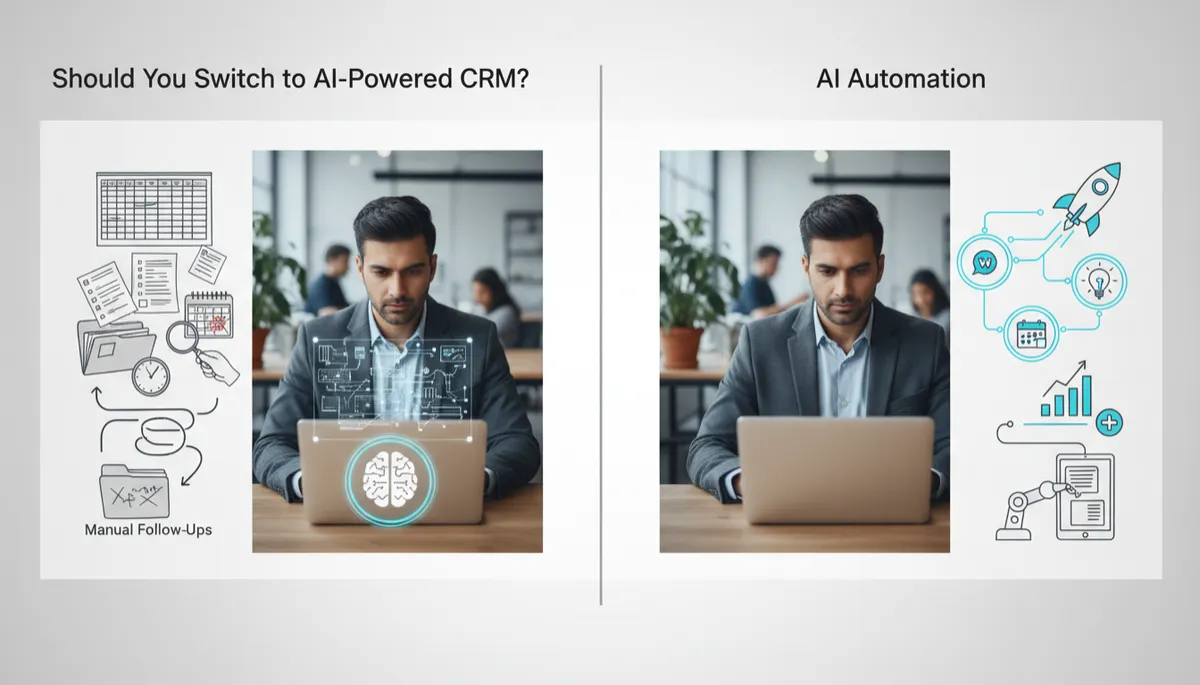
Switch to AI-Powered CRM for Business Growth
CRM, AI CRM, Small Business Growth
Should You Switch to an AI-Powered CRM?
If you are wondering whether you should switch to an AI-powered CRM, the honest answer is this: if you rely on people, calls, WhatsApp, and follow-ups to grow your revenue, you will almost certainly need an AI CRM in the next 12–18 months — the only real question is whether you move early and benefit, or wait and play catch-up later.

For small business owners, coaches, agencies, and service providers across India, the CRM upgrade decision is no longer about “Do I need software?” but “Is it time to switch to AI-powered CRM so my team stops wasting time on manual work and starts closing more business?” This guide will help you answer that in a practical, numbers-backed way — without jargon and without hype.
What's the Real Difference Between a Traditional CRM and an AI-Powered One?
Let's start with the heart of the AI CRM vs traditional CRM debate. Most small businesses in India today sit in one of three buckets:
- Spreadsheets + WhatsApp + Google Contacts — everything lives in someone’s head and a few shared files.
- Basic CRM — a place to store leads, deals, and maybe send a few emails, but still a lot of manual work.
- AI-powered CRM — the system itself suggests what to do, when to follow up, and even drafts the messages.
Traditional CRM: A Smarter Spreadsheet
A traditional CRM is essentially a structured database with reminders. It helps you:
- Store contact details and deal stages in one place.
- Track who called whom and when the next follow-up is due.
- Pull basic reports — monthly revenue, pipeline, conversion rate.
But you or your team must decide whom to call, what to say, when to send a reminder, and how to prioritise leads. The system is passive; it waits for instructions and data entry. That’s why Salesforce’s State of Sales 2026 shows reps still spend around 60% of their week on non-selling tasks like manual data entry and admin.
AI-Powered CRM: An Intelligent Sales and Service Assistant
When you switch to AI-powered CRM, the system doesn’t just store information — it actively helps you sell and serve better. An AI CRM typically:
- Scores and prioritises leads based on behaviour, past conversions, and engagement, so your team focuses on the hottest opportunities first.
- Automates follow-ups on WhatsApp, SMS, and email, so no lead “slips through the cracks” because someone forgot to reply.
- Understands intent and sentiment in messages and calls, flagging angry customers or high-intent buyers for faster action.
- Drafts replies, proposals, and follow-up messages for your team to approve, cutting writing time drastically.
Freshworks’ 2024 CRM survey found that 65% of businesses now use CRM with generative AI, and those using AI CRM are 83% more likely to exceed their sales goals. That’s not a small edge — that’s a competitive gap that widens every quarter you delay your CRM upgrade decision.
5 Signs You've Outgrown Your Current CRM
Not every business needs to switch to AI-powered CRM today. But many are already paying the price of staying on a basic tool. If you recognise these signs, you have likely outgrown your current setup.
1. Your Follow-Ups Depend on Memory and Manual Reminders
If your team is still saying “I’ll remember to call him on Monday” or using sticky notes and personal reminders, you’re losing money. Human memory is not a reliable sales system. An AI CRM for small business in India can auto-create follow-up sequences the moment a lead comes in — without your salesperson doing anything extra.
2. You Can’t Clearly See Which Leads Are Worth Your Time
When you open your CRM or spreadsheet, do all leads look the same? In reality, a lead who visited your pricing page twice and replied on WhatsApp is far hotter than someone who just downloaded a free guide. AI lead scoring automatically ranks them so your team spends their limited time on the top 20% that will drive 80% of revenue.
3. Your Team Juggles Too Many Tools and Loses Context
A typical Indian small business tech stack today: WhatsApp, email, spreadsheets, maybe a basic CRM, payment links, and a booking tool. Every time your team switches tabs, they lose context and time. Salesforce’s State of Sales 2026 highlights that this kind of tool sprawl is a major reason reps spend only 40% of their week actually selling. An AI CRM consolidates these channels so your team works from one place, not seven.
4. Your Response Time Is Slipping as You Grow
When you had 20 leads a week, replying within a few minutes on WhatsApp was easy. At 200 leads a week, it’s impossible without automation. Industry research shows AI CRM can reduce response time to customer queries by up to 70%. Faster response means you win the deal before your competitor even replies with “Hi”.
5. Reporting Feels Like Guesswork, Not a Dashboard
If your monthly review meeting still involves downloading data from a CRM or spreadsheet, cleaning it manually, and then trying to make sense of it, you’re behind. AI CRM can auto-generate insights like “Your conversion rate from WhatsApp leads is 2x email” or “Leads from Instagram close 30% faster than Google Ads,” helping you shift budgets confidently.
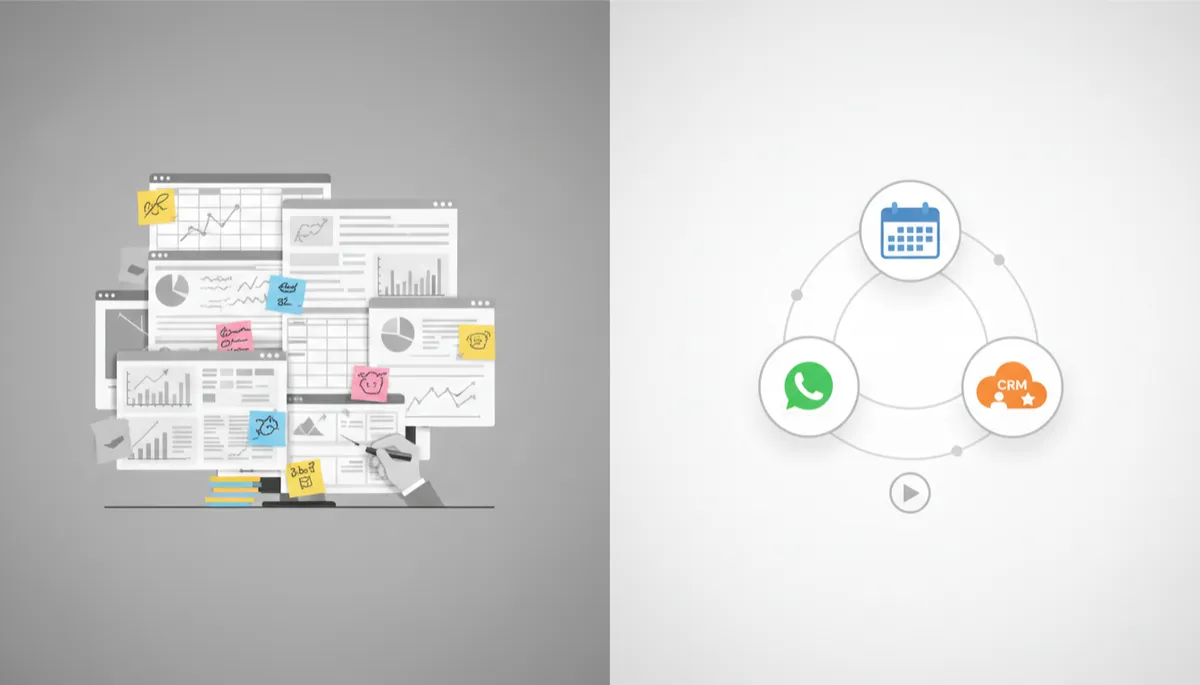
Moving from manual tracking to AI-driven workflows frees hours every week for selling.
What AI Actually Does Inside a Modern CRM
“AI” can sound abstract until you see what it does in your daily operations. Here are the practical capabilities you should expect when you switch to AI-powered CRM.
Intelligent Lead Scoring and Prioritisation
AI looks at your historical data — who converted, which channels performed, how many touchpoints it took — and then scores new leads automatically. Instead of your sales rep asking “Whom should I call first?”, the CRM tells them: “Start with these 15 leads; they are most likely to buy this week.”
Follow-Up Automation on WhatsApp and Beyond
For Indian businesses, WhatsApp is often more important than email. A modern AI CRM for small business should:
- Capture leads directly from WhatsApp, forms, and ads into the CRM.
- Trigger instant welcome messages, FAQs, and reminders on WhatsApp without manual typing.
- Hand over to a human agent when the conversation needs personal attention.
This alone can handle 60–70% of routine conversations so your team can focus on high-value calls and demos.
Smart Appointment Booking and Reminders
Instead of back-and-forth messages like “Are you free at 4 pm?” an AI-powered CRM can send a booking link, sync with your calendar, and automatically:
- Confirm the slot, send a WhatsApp reminder, and share meeting links or location.
- Trigger post-meeting follow-ups and feedback requests without your team lifting a finger.
Sentiment Analysis and Risk Alerts
AI can scan messages and call transcripts to detect frustration, urgency, or high buying intent. For example, if a client types “I’m very unhappy with your service,” the CRM can instantly:
- Flag the conversation as high-risk,
- Notify a manager, and
- Suggest a calming, professional reply your agent can send with one click.
Content Drafting and Deal Support
Instead of your sales team spending half an hour writing a follow-up email or proposal, AI can draft:
- Personalised follow-up messages based on the last conversation,
- Quick summaries of calls for your CRM notes, and
- Proposal outlines using your existing templates.
Your team simply reviews and edits, instead of starting from a blank page every time.
The Business Case for Switching — What the Numbers Say
Emotionally, AI CRM sounds exciting. Financially, it must make sense. Let’s look at real numbers from credible research so you can decide with confidence.
ROI: Is AI CRM Actually Worth the Money?
Nucleus Research has consistently found that CRM delivers an average ROI of $8.71 for every $1 invested. That’s for CRM in general — not even specifically AI CRM. When you add automation and intelligence, the return typically improves because you reduce manual work and close more deals with the same team size.
Freshworks’ 2024 survey reports that 43% of businesses save 5–10 hours per employee per week by automating repetitive CRM tasks. Imagine you have a team of five salespeople. Conservatively, saving 5 hours each per week gives you 25 extra hours — effectively more than half an extra full-time salesperson, without hiring anyone.
Revenue Impact: More Leads Converted, Faster
Across industries, 74% of organizations using AI CRM report at least a 10% increase in lead conversion rates. Combine that with the fact that AI CRM can cut response times by up to 70%, and you get a simple picture: the business that replies first with a professional, personalised message usually wins the deal.
A peer-reviewed study published on PMC/NIH in 2024 confirms that AI-CRM features directly improve organizational competitive advantage — not just internal efficiency. In plain language: companies that adopt AI CRM don’t just work faster; they actually pull ahead of competitors in their market.
Market Direction: Is AI CRM Just a Trend?
Grand View Research estimates that the overall CRM market is growing steadily, and AI-powered CRM is the fastest-rising segment, projected to grow at around 23.8% CAGR from 2023 to 2031 — from $14.9 billion to $48.4 billion. In simple terms, global investment is flowing heavily into AI CRM, not older models. You don’t want to build your 2026–2030 growth strategy on a technology the world is moving away from.
Objections Business Owners Raise (And Honest Answers)
“It Sounds Expensive — Can I Just Manage With What I Have?”
Cost is a valid concern, especially in the Indian SME context where margins can be tight. But the real question is: What is the cost of not upgrading? If each salesperson wastes 5–10 hours a week on manual work that AI could automate, you’re paying salary for low-value tasks instead of revenue-generating ones. Over a year, that “hidden cost” can exceed the subscription fee several times over.
“My Team Won’t Adopt a New System — They Already Resist the Current CRM”
Resistance usually comes from tools that create more work than they save. Many traditional CRMs feel like extra admin — updating fields, logging calls, filling forms. A well-designed AI CRM flips this: your team gets value immediately in the form of drafted messages, prioritised leads, and fewer manual tasks. Adoption becomes easier when the system feels like a personal assistant, not a surveillance tool.
“We Already Have a CRM That Works Fine — Why Rock the Boat?”
“Fine” is the danger zone. It means you’re not in pain today, but you’re slowly falling behind competitors who are compounding AI advantages every quarter. Remember, businesses using AI CRM are 83% more likely to exceed their sales goals. Even if your current CRM feels comfortable, it may be quietly capping your growth potential for the next 3–5 years.
“Will AI Replace My Sales Team?”
No. AI CRM is best at replacing low-value tasks — typing the same follow-up message 50 times, copying data between tools, manually scheduling calls. Your team’s human skills — listening, negotiating, building trust — become even more valuable when AI handles the drudgery. Think of AI as a junior assistant for every salesperson, not a replacement.
A Simple Decision Framework: Should YOU Switch?
Use this 5-point checklist to evaluate your own situation. If you answer “Yes” to three or more, it’s time to seriously consider a switch to AI-powered CRM.
| Question | Your Answer (Yes/No) |
|---|---|
| 1. Are leads slipping through the cracks because of delayed or missed follow-ups? | |
| 2. Do your sales or coaching teams spend more than 50% of their time on admin and coordination? | |
| 3. Is WhatsApp a major channel for your business, but not properly integrated with your CRM? | |
| 4. Do you lack clear visibility into which campaigns and channels actually drive profitable revenue? | |
| 5. Are you planning to grow 2–3x in the next 2–3 years without proportionally increasing headcount? |
If you're nodding along to most of these points, it might be worth seeing what an AI CRM actually looks like in practice.
What to Look for in an AI-Powered CRM Before You Commit
Not all AI CRMs are created equal. Some simply add a chatbot and call it “AI”. Before you sign up, use this feature checklist to evaluate whether the platform can genuinely support your growth.
1. Automation Depth, Not Just Fancy Dashboards
Ask: Which specific tasks will this AI CRM take off my team’s plate from Day 1? Look for:
- Lead capture and enrichment automation,
- Follow-up and reminder workflows,
- Automatic note-taking or call summaries,
- Smart routing of leads to the right team member.
2. Native WhatsApp Integration for the Indian Market
For Indian SMEs, WhatsApp is where most real conversations happen. Your AI CRM should:
- Support official WhatsApp Business APIs, not just browser hacks,
- Log all chats automatically against the right contact and deal, and
- Enable AI-powered templates and quick replies that your team can personalise.
3. No-Code Setup and Easy Onboarding
You shouldn’t need a full-time IT admin to run your CRM. Look for:
- No-code workflow builders for automations,
- Pre-built templates for common use cases — coaching, agency, consulting, local services, and
- Guided onboarding and training tailored to non-technical teams.
4. Lead Nurturing and Review Management
The real value of AI CRM is in nurturing and retaining customers, not just closing one sale. Strong platforms help you:
- Run drip campaigns for leads who are “not ready yet,”
- Request and manage Google reviews or testimonials automatically, and
- Reactivate old leads with personalised offers based on their past behaviour.
5. Local Support and Strategic Guidance
Tools are only as good as the strategy behind them. That’s why many Indian businesses work with specialists like Revenue Mastery Consulting to design their sales and CRM systems end-to-end. You want a partner who understands Indian buyer behaviour, WhatsApp culture, and your industry’s realities — not just generic “global best practices.”
For example, Avinash N U has worked closely with founders, coaches, and agencies to design AI-enhanced revenue systems that match how Indian teams actually sell and follow up, not how a Silicon Valley playbook assumes they should.
Frequently Asked Questions
1. Is switching to an AI CRM difficult?
It doesn’t have to be. A well-implemented switch happens in phases: migrate your existing contacts and deals, connect your main channels (WhatsApp, forms, email), and then layer in automations one by one. The right platform and partner will handle most of the technical work, while your team focuses on learning how to use the new “assistant” they now have inside the CRM.
2. How long does it take to see results?
Most small businesses start seeing visible benefits — faster responses, fewer missed follow-ups, clearer dashboards — within 30–60 days. Deeper gains like higher conversion rates and better customer lifetime value typically show up over 3–6 months as the AI learns from your data and you refine your workflows. Remember, even saving 5 hours per person per week is an immediate, measurable win.
3. Can a small business really afford an AI CRM?
Yes — in fact, small businesses often benefit the most because they can’t afford to throw people at every problem. When you factor in the ROI numbers (CRM delivering around $8.71 for every $1 invested, and AI CRM saving 5–10 hours per employee per week), the question becomes: can you afford not to upgrade, especially if your competitors are adopting AI CRM benefits in 2026 and beyond?
4. Does an AI CRM replace my sales team?
No. AI CRM replaces repetitive tasks, not people. Your team still builds relationships, runs discovery calls, handles objections, and closes deals. The AI simply ensures they spend more time doing that, and less time copying data, typing the same messages, or chasing no-shows. In most successful implementations, salespeople feel relieved, not threatened, because their day becomes more about meaningful work and less about admin.
5. What's the first thing I should automate if I switch?
Start with the highest-volume, lowest-risk workflows. For most Indian SMEs, that means:
- Capturing leads from forms and ads directly into the CRM,
- Sending instant WhatsApp acknowledgements and basic FAQs, and
- Scheduling and reminding for calls or sessions automatically.
Once your team sees these wins, you can gradually add advanced lead scoring, nurturing, and reactivation campaigns.
Final Thoughts: Should You Switch to an AI-Powered CRM?
Coming back to the original question — Should you switch to an AI-powered CRM? If your growth depends on consistent follow-ups, WhatsApp conversations, and a small team doing the work of a much larger one, the answer is increasingly “yes.” The data is clear: AI CRM users close more deals, respond faster, and save hours every week, while the overall market is racing toward AI-first platforms.
The real risk isn’t in upgrading — it’s in standing still while your competitors quietly build AI-augmented systems that compound every quarter. A thoughtful, phased switch now can protect your margins, free your team from drudgery, and position your brand as the one that always responds first, follows up consistently, and never drops the ball.
References & Links
- Freshworks 2024 CRM Survey – CRM statistics and AI adoption: https://www.freshworks.com/theworks/company-news/crm-statistics/
- Salesforce State of Sales Report 2026 – Time spent selling and AI impact: https://www.salesforce.com/resources/research-reports/state-of-sales/
- Grand View Research – CRM market size and AI CRM growth: https://www.grandviewresearch.com/industry-analysis/customer-relationship-management-crm-market
- PMC/NIH Peer-Reviewed Study – AI-CRM features and competitive advantage: https://pmc.ncbi.nlm.nih.gov/articles/PMC11382090/
- Revenue Mastery Consulting – Strategy and implementation support: https://revenuemasteryconsulting.com/
- Profile of Chief Strategist Avinash N U: https://revenuemasteryconsulting.com/chief-strategist-avinash-n-u
- RevMax WhatsApp CRM Experience: https://whatsapp.studio.revmaxapp.com/