Is Your CRM Outdated Without AI in 2026?
CRM, Artificial Intelligence, Sales Automation, WhatsApp Integration
Is Your Current CRM Outdated Without AI?
In 2026, asking “is my CRM outdated without AI?” is like asking if a smartphone without apps is enough for business—technically, it works, but you are competing with people using something far more capable. A CRM without AI is now a drag on speed, follow-up, and revenue, yet “outdated” does not mean you must rip everything out tomorrow. Instead, treat this as a diagnostic: let’s run through seven clear warning signs to see whether your current system is quietly costing you growth.

This guide is written for business owners who already use a CRM—maybe a legacy tool, maybe a basic cloud system—and are wondering if it is still competitive. You are not looking to switch for vanity. You want to know, clinically, whether your current CRM is now a liability.
The Problem With “Good Enough” CRMs in 2026
For years, “we have a CRM” was enough. If your team could log contacts, track deals, and send basic emails, you were ahead of the spreadsheet crowd. In 2026, that baseline has shifted. AI, automation, and channel integration—especially WhatsApp—have moved the goalposts for what “good enough” means.
Research from Freshworks in 2024 shows that 65% of businesses now use CRM systems with generative AI baked in, and those using AI are 83% more likely to exceed their sales goals than those without it. That means if you are running a CRM without AI in 2026, you are no longer in the mainstream—you are in the shrinking minority, competing against teams whose systems do more work automatically than your team can do manually in a week.
At the same time, the workload on your people has not shrunk. Salesforce’s State of Sales research shows sales reps now spend only about 40% of their week actually selling; the rest is admin, data entry, and follow-up. A CRM that does not use AI to cut that 60% admin burden is not “fine”—it is a hidden cost center you pay for every month in salaries, missed follow-ups, and slower response times.
So the real question is not whether your CRM opens and runs. It is whether it still helps you compete in a market where AI automation, instant messaging, and predictive insights are fast becoming the norm.
7 Signs Your Current CRM Is Holding Your Business Back
Use these seven signs as a diagnostic checklist. The more you say “yes,” the more likely it is that your CRM is outdated without AI and costing you real money, not just convenience.
Sign 1 — Your team manually logs every call, email, and meeting
If your reps have to remember to log each call, email, and WhatsApp conversation, you are running your CRM like it is still 2015. Manual logging is one of the biggest productivity drains in sales and service teams. Industry research shows 23% of users cite manual data entry as a major obstacle in their current CRM. It is boring, error-prone, and the first thing people skip when they are busy.
The cost is not just time. When activities are not logged, your reports lie. Pipeline reviews become guesswork, new hires cannot see the full history of an account, and managers cannot coach effectively because the data is incomplete. You are flying blind with partial visibility, even though you are “using a CRM.”
Sign 2 — You have no way to predict which leads are most likely to close
When your team looks at a list of leads, do they know—based on data—who is most likely to buy this week? Or are they guessing based on who “seems interested” or “sounds serious”? If your CRM cannot score leads using behavior, history, and patterns, you are leaving conversion rates to chance.
Modern AI CRM features use predictive analytics to surface the hottest opportunities automatically. They look at opens, replies, call outcomes, time since last interaction, and even sentiment in messages to tell your team, “Call these five people first today.” Without that, high-intent leads can sit untouched while your team chases low-probability prospects simply because they shouted the loudest last week.
Sign 3 — Follow-ups depend entirely on your team remembering to do them
Be honest: how many deals have gone cold in the last 90 days simply because no one followed up at the right time? In most legacy CRMs, follow-ups are calendar reminders or tasks that humans must create and then remember to execute. When things get busy, those reminders get snoozed, then ignored, then forgotten.
AI-driven CRMs flip this model. They automatically schedule and trigger follow-ups based on rules and behavior—no memory required. Response times can drop by up to 70% when follow-up is automated instead of manual, because the system pushes the next step instead of waiting for someone to remember it. If your CRM is not doing that for you, your team is overcompensating every single day.
Sign 4 — Customer enquiries go unanswered outside of business hours
Prospects now expect replies in minutes, not days. If someone messages you on WhatsApp or submits a web form at 9:30 p.m., does your CRM respond instantly with a relevant answer, or do they wait until the next morning when your team logs in? Every hour of delay increases the chance they speak to a competitor instead of you.
AI-powered chat and messaging can handle common questions, qualify leads, and book appointments 24/7. A CRM without AI in 2026 is effectively blind and mute outside working hours. You pay for leads with ads and marketing—but if your system cannot respond in real time, you are leaking that spend straight to competitors who can.
Sign 5 — You can’t send WhatsApp messages from inside your CRM
In 2026, 74% of SMEs say integration with other business tools—especially WhatsApp—is their number one CRM priority. If your team has to juggle between your CRM and separate WhatsApp devices or web tabs, you have a broken workflow. Conversations are not fully captured, context is lost, and you cannot see a unified history of each customer’s journey.
A modern AI CRM upgrade treats WhatsApp as a first-class channel. Your team can send, receive, and automate WhatsApp messages directly inside the CRM, with templates, personalization, and AI-written responses. If that sounds far from what you have today, it is a strong outdated CRM sign you should not ignore.
Sign 6 — Your pipeline is based on gut feel, not real data
In pipeline reviews, do you hear phrases like “I think this will close,” “They sounded positive,” or “Let’s keep it in next month’s forecast” with no data behind them? That is a sign your CRM is functioning as a glorified contact list, not a decision system. Without AI-driven insights, your forecasts are vulnerable to optimism bias and blind spots.
AI CRMs analyze historical win rates, deal velocity, stakeholder engagement, and deal activity to flag which opportunities are truly at risk and which are likely to close. They move you from “we feel” to “the data shows.” If your current reports cannot answer basic questions like “Which stage has the highest leakage?” or “Which source gives us the highest lifetime value?”, your system is behind where the market already is.
Sign 7 — Your CRM doesn’t automatically ask for reviews after a sale
Reviews and referrals are one of the highest-ROI growth levers. Yet in many businesses, asking for reviews is an afterthought: “If you remember, please ask them to leave a review.” That is not a strategy; it is a wish. A CRM without AI usually has no systematic way to trigger review requests at the right time, on the right channel, with the right message.
A modern AI CRM can detect when a deal moves to “Won,” wait a sensible period, then send a personalized WhatsApp or email asking for a review—without your team lifting a finger. Over a year, that can mean dozens or hundreds of extra reviews, which directly impact conversion rates and trust. If your current CRM is silent after the sale, you are leaving long-term revenue on the table.
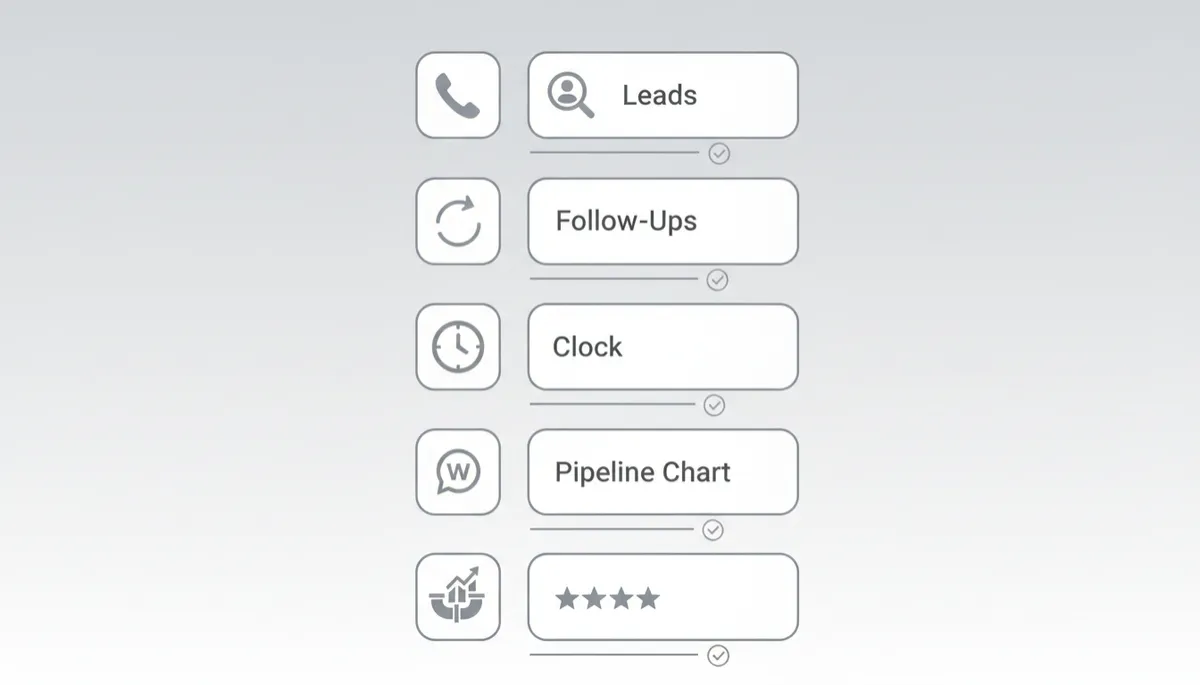
Use a simple seven-point checklist to reveal where your CRM is quietly underperforming.
“But My CRM Works Fine” — The Comfortable Trap
Many owners say, “Our CRM works fine. The team knows how to use it. Why change?” That is a rational reaction—until you look at the opportunity cost. The real risk is not that your current CRM crashes; it is that it quietly limits what your team can achieve every week while your competitors’ systems do more with less effort.
Freshworks reports that 43% of businesses save 5–10 hours per employee every week by automating CRM tasks. If your CRM does not use AI automation, you are effectively paying your staff to do what software should be doing—copy-pasting data, chasing follow-ups, and digging through threads to find context. Over a year, that is weeks of lost selling time per person, even before you consider the impact on morale and burnout.
There is also a data quality trap. Studies show 37% of CRM users report revenue loss directly tied to poor data quality. When your system relies on manual entry and scattered channels, your data decays faster. AI CRMs can auto-enrich, deduplicate, and correct records, turning messy inputs into usable intelligence. Sticking with “fine” means accepting bad data as a permanent handicap in your decision-making.
Want to see what your CRM could be doing that it currently is not—without guessing? Curious what a modern AI CRM actually looks like? See RevMax in action and compare it directly with your existing setup.
What a Modern AI CRM Does That Yours Probably Doesn’t
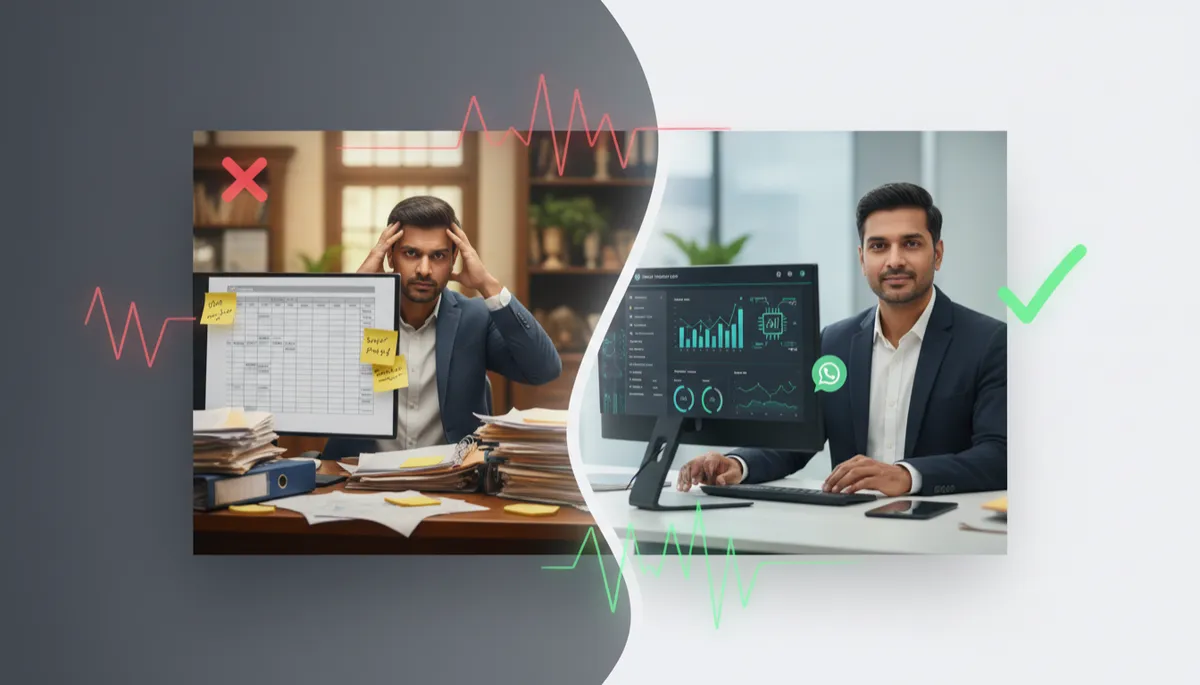
To make this concrete, let’s map each of the seven signs to what an AI CRM upgrade actually changes in day-to-day operations. Think of this as a before/after diagnostic, not theory.
From manual logging to automatic capture
Before: Your team logs calls when they remember. Emails live partly in inboxes, partly in the CRM. WhatsApp conversations are mostly on personal phones. Reports are always “approximately right,” never precise. Training new reps means asking them to trust data they suspect is incomplete.
After: The CRM automatically records calls, emails, and WhatsApp messages to the right contact and deal. AI summarizes long conversations into key points—objections, next steps, budget—and updates fields accordingly. Your team spends time selling, not typing, and management finally sees the full picture without chasing people for updates.
From guessing hot leads to AI lead scoring
Before: Reps call whoever is at the top of the list or whoever shouted loudest last week. High-intent leads sometimes wait days for contact because they filled in a form at the wrong time. Marketing and sales argue about “lead quality” without shared evidence.
After: AI scores leads in real time based on behavior and history. Your team sees a prioritized list every morning: “These 10 are likely to close this week.” Managers can see which campaigns generate the highest-scoring leads. You stop treating all leads as equal and start focusing effort where the probability of revenue is highest.
From memory-based follow-ups to automated journeys
Before: Follow-ups live in people’s heads or scattered calendar reminders. When a key rep is on leave, deals stall. Prospects slip through the cracks after the second or third touch because everyone is overwhelmed with new leads and urgent fires.
After: AI-driven workflows trigger follow-ups automatically: WhatsApp nudges, email sequences, reminder tasks, even call suggestions based on engagement. The system adapts to behavior—pausing if a prospect replies, escalating if they go silent. Response times drop, consistency rises, and your pipeline keeps moving even during holidays or staff turnover.
From office-hours support to 24/7 smart responses
Before: Leads who message outside hours wait. Your team returns in the morning to a backlog of chats and emails. Some prospects have already moved on. Others have cooled off. You spend the first hours of each day catching up instead of moving forward.
After: AI chat and WhatsApp bots answer common questions, qualify leads, and even book appointments while you sleep. They hand off complex cases to humans with full conversation history. You become the business that “always replies fast,” without hiring a night shift or burning out your existing team.
From WhatsApp chaos to unified, trackable conversations
Before: Sales reps use personal WhatsApp accounts. When someone leaves, you lose the chat history. Managers cannot see what was promised. Compliance is a concern. You cannot scale messaging without losing control and context, and you definitely cannot measure which WhatsApp campaigns actually drive revenue.
After: WhatsApp is integrated directly inside the CRM. Conversations are attached to contacts and deals. AI can suggest replies, translate messages, and personalize templates. Broadcasts, sequences, and one-to-one chats all live in one place. You get the speed and intimacy of WhatsApp without sacrificing control or data.
From gut-feel pipeline to data-driven forecasting
Before: Forecast meetings revolve around opinions. Deals linger in late stages for months. You are surprised by shortfalls and overperformance because your CRM cannot see patterns, it only stores snapshots. Leaders spend more time challenging numbers than planning action.
After: AI analyzes your historical data to predict likely close dates and probabilities. It flags stuck deals, highlights reps who are over- or under-forecasting, and shows where in the funnel you lose the most value. Instead of debating whether the numbers are true, you use them to decide what to fix next.
From forgotten reviews to automated reputation building
Before: Reviews happen when a particularly happy customer takes the initiative—or when a rep remembers to ask. Your online reputation grows slowly and unevenly, with no clear link between customer satisfaction and public proof. Referrals are informal and unpredictable.
After: Every “Won” deal triggers an automated, personalized review request, often via WhatsApp where response rates are higher. AI tailors the message to the customer’s journey. Over time, you build a steady stream of fresh reviews without chasing people manually, and your CRM becomes a reputation engine, not just a database.
The Competitive Advantage You’re Leaving on the Table
A peer-reviewed 2024 study published in Heliyon and available via PMC confirms what many business leaders are already sensing: AI-CRM capabilities are directly linked to organizational competitive advantage. Companies that embed AI into their CRM workflows do not just get marginal gains—they change how fast they can respond, learn, and adapt compared to peers still running manual processes.
Freshworks’ 2024 CRM survey adds hard numbers to that story. Businesses using generative AI in their CRM are 83% more likely to exceed sales goals. They also report saving 5–10 hours per employee per week through automation and centralized data. If your CRM without AI in 2026 is not delivering similar time savings, you are effectively donating that competitive edge to others in your market who have upgraded.
Response speed is another battlefield. AI-powered automation can cut response times by up to 70% compared to manual follow-up. In markets where prospects often contact three to five vendors, being the first to respond with a clear, helpful answer is a massive advantage. Your current CRM may feel “stable,” but if it cannot help you respond faster, it is quietly putting you second or third in line for the same lead you paid to acquire.
Finally, there is the compounding effect of better data. When AI helps clean, enrich, and interpret CRM data, your decisions improve month after month. You learn which products, segments, and channels truly drive lifetime value. Without that, you are making strategy decisions based on partial, noisy information. Over three to five years, that difference in decision quality compounds into a serious performance gap.
A Simple Self-Assessment: Score Your CRM
Use this seven-question checklist as a quick self-assessment. Answer “Yes” if the statement accurately describes your current CRM today. Answer honestly—this is a diagnostic, not a sales pitch.
- Our team still spends significant time manually logging calls, emails, or WhatsApp messages into the CRM.
- We do not have reliable, AI-driven lead scoring that clearly shows which leads are most likely to close this week.
- Follow-ups mainly depend on individual team members remembering or setting manual reminders.
- Customer enquiries that arrive outside business hours usually wait until the next working day for a response.
- We cannot send and track WhatsApp messages directly from inside our CRM in a structured, centralized way.
- Our sales pipeline and forecasts are based largely on gut feel rather than AI-assisted analysis of historical data.
- Our CRM does not automatically trigger personalized review requests or referral campaigns after a sale is closed.
If you want a strategic partner to help you interpret your score and build a realistic roadmap, firms like Revenue Mastery Consulting specialize in aligning CRM, AI, and revenue operations. Their chief strategist, Avinash N U, has worked with growth-focused businesses to turn CRM from a static tool into a live revenue engine.
Frequently Asked Questions
How do I know if my CRM needs an AI upgrade?
Start with the seven-point checklist above. If you answered “Yes” to at least three questions, your CRM without AI in 2026 is likely limiting performance. Look specifically at where your team spends time on repetitive admin, where leads slip through the cracks, and where you lack visibility into which activities actually drive revenue. Those are prime candidates for AI automation and insight.
Can I add AI features to my existing CRM?
In some cases, yes—many legacy CRMs now offer AI add-ons or marketplace apps. However, bolting AI onto an outdated architecture can feel like adding a jet engine to a bicycle. You may get partial benefits, but you will still fight with clunky workflows, poor WhatsApp integration, and fragmented data. Evaluate whether the cost and complexity of patching your current system outweigh the benefits of moving to a platform designed around AI from the start, like RevMax.
How long does it take to migrate to an AI CRM?
For most small and mid-sized businesses, a well-planned migration can be executed in weeks, not years. The critical steps are: auditing your existing data, cleaning and mapping fields, designing your new workflows (especially around WhatsApp, follow-ups, and reviews), and training your team. The more focused your first rollout is—starting with one or two high-impact use cases—the smoother the transition will be. A phased approach lets you see ROI early while minimizing disruption.
Will switching CRMs disrupt my business?
Any change introduces short-term friction, but staying with an outdated CRM has ongoing, long-term costs. The key is to manage the transition like a revenue-critical project, not an IT experiment. Choose a platform with clear migration tools, strong onboarding support, and built-in automation templates. Communicate clearly with your team about why you are upgrading—less manual work, faster responses, more closed deals—so they see the benefit quickly instead of just “another system to learn.”
Is a CRM without AI still useful in 2026?
Yes, it is still useful in the same way a basic phone is useful—you can call and text. But when 65% of businesses already use AI-enabled CRMs, and those using AI are dramatically more likely to exceed sales goals, “useful” is not the same as “competitive.” A non-AI CRM can still store contacts and deals, but it asks your team to manually do work—logging, prioritizing, following up, responding—that software can now handle automatically and more consistently.
Final Diagnosis: Is Your CRM Quietly Costing You Growth?
In 2026, a CRM without AI is not just a little behind the curve. It is a system that requires your team to manually compensate for everything modern software can now do automatically—capturing conversations, prioritizing leads, triggering follow-ups, responding on WhatsApp, and building your reputation after every sale. The hidden cost is not the subscription fee you pay; it is the leads you lose, the hours you waste, and the insights you never see because your CRM simply is not capable of more.
If your diagnostic checklist lit up with multiple warning signs, treat this as a clear signal. An AI CRM upgrade is no longer a futuristic experiment; it is a practical, measurable way to reclaim selling time, protect your lead spend, and stay in step with how your customers actually want to communicate—especially on WhatsApp. The sooner you act, the sooner your CRM shifts from being a passive database to an active growth engine.
Run your business on an AI CRM that actually sells with you
References & Links
- Freshworks 2024 CRM Survey — https://www.freshworks.com/theworks/company-news/crm-statistics/
- Salesforce State of Sales — https://www.salesforce.com/resources/research-reports/state-of-sales/
- Heliyon / PMC — AI-CRM Competitive Advantage Study — https://pmc.ncbi.nlm.nih.gov/articles/PMC11382090/
- ScienceDirect — Unlocking the Power of AI in CRM — https://www.sciencedirect.com/science/article/pii/S2444569X25000769
- Revenue Mastery Consulting — https://revenuemasteryconsulting.com/
- RevMax WhatsApp Studio — https://whatsapp.studio.revmaxapp.com/