
Is Free AI CRM Software Worth It in 2026?
CRM, AI CRM, Small Business, India, Free vs Paid
Is Free AI CRM Software Actually Worth It?
“Free AI CRM” sounds like the perfect jugaad: zero rupees, full automation, and an AI assistant that never sleeps. The honest truth in 2026? It depends where you are in your business journey — but for most growing teams, “free AI CRM” is largely a myth. The AI is usually the first thing stripped from free tiers, leaving you with a glorified contact spreadsheet and a long list of locked features.
The Big Lie About “Free AI CRM” in 2026
Let’s start with the uncomfortable bit: “free AI CRM” is mostly a marketing phrase, not a product description. In 2026, almost every big CRM shouts about AI on its homepage — predictive insights, smart recommendations, automated follow-ups, even agentic AI that can take actions on its own. But when you click into the free plan details, the magic quietly disappears.
Across the industry, AI features like lead scoring, predictive analytics, automated workflows, and conversational agents are either disabled, heavily throttled, or locked behind usage-based credits. That’s not an accident. It’s the business model. Free tiers are designed to let you taste the interface, not the intelligence running behind it (SaaSCRMReview).
Research on CRM pricing shows that roughly three-quarters of CRM tools are paid-only with no free tier at all, and the rest keep their serious automation and AI behind paywalls (Toolradar, 2026). When you do see “AI” mentioned in a free plan, it usually means light assistive features: draft an email, summarise a note, maybe suggest a next step — not the revenue-driving automation most business owners imagine when they hear “AI CRM”.
What Free CRM Plans Actually Include (And What They Don’t)
What’s usually included in a free tier
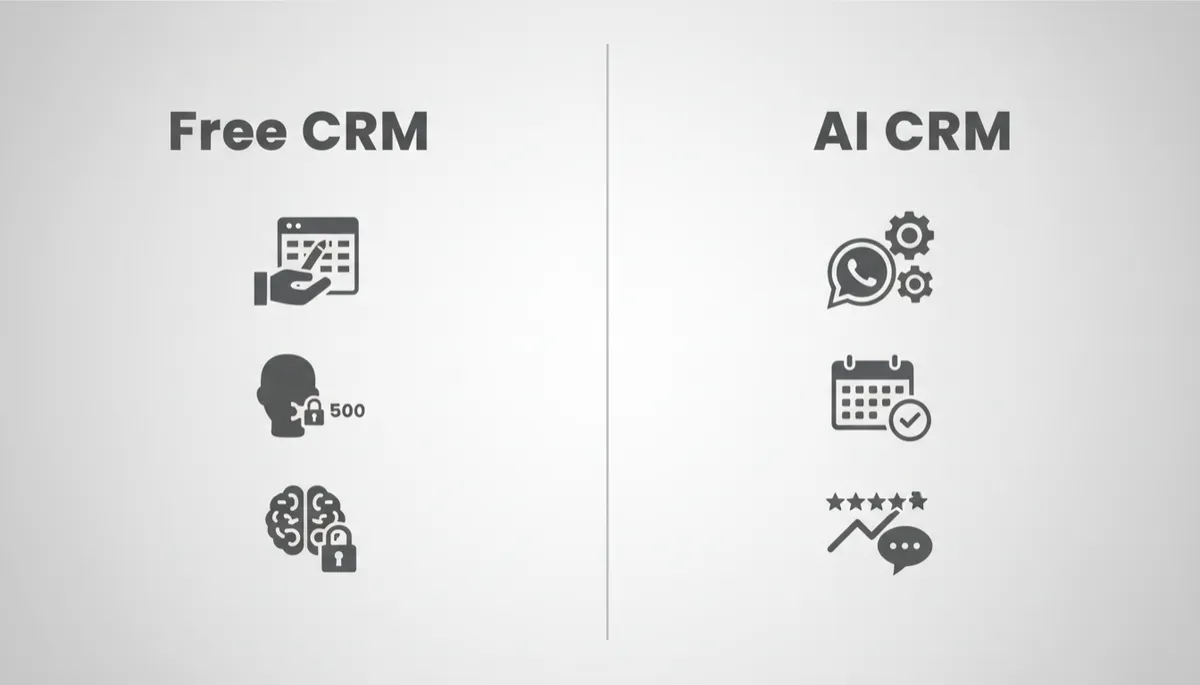
Strip away the buzzwords and most free plans look surprisingly similar. Think of them as a slightly disciplined version of your Excel sheet, dressed up with a nicer UI. Typically, you’ll get:
- Basic contact management — store names, numbers, emails, a few custom fields, maybe a timeline of interactions.
- Simple pipeline or deal stages — Kanban-style boards where you drag deals from “New” to “Won/Lost”.
- Limited users — usually 1–3 users on the free tier, just enough for a founder and maybe one salesperson to try it out (Autometa, 2026).
- Contact caps — typically 250–1,000 contacts in 2026, which sounds generous until your ad campaigns start working and you hit the ceiling in a month or two.
- Basic email tracking — open/click tracking and maybe a few simple templates, often with small monthly sending limits.
- Simple web forms — embed a lead form on your website or landing page, with the CRM capturing submissions as contacts.
In other words, free tiers are fine for storing data and doing manual follow-up. They don’t run your sales process; they just record what your team manually remembers to do.
What’s almost always locked behind paid tiers
Now the important part — what you don’t get on free plans, especially when it comes to AI. Across the board, the following are either disabled or severely restricted in free tiers:
- AI lead scoring — the system automatically ranking leads based on behaviour, intent, and fit. This is one of the first things paywalled, because it directly impacts revenue.
- Workflow automation — multi-step sequences like “if lead fills form, send WhatsApp, assign to sales rep, create task, send reminder if no reply in 24 hours”. On free tiers, you’re usually stuck doing all of this manually or with one tiny rule that barely helps (Zendikt, 2026).
- WhatsApp integration — especially critical in India. Most free CRMs offer email; WhatsApp automation is almost never included. Sending broadcasts, templates, or 1:1 messages from inside the CRM is firmly a paid feature.
- Appointment booking — calendar sync, automated meeting links, and reminders for demos or consultations are typically locked behind paid plans or add-ons.
- Review automation — sending automated Google review requests after a purchase or service completion is rarely, if ever, included in free tiers. Yet those reviews heavily influence your local SEO and trust.
- Custom reporting and dashboards — you might get one or two fixed reports, but anything like “conversion rate by campaign over last 90 days” is usually a paid luxury.
- Priority support and onboarding — free users are pushed to help docs and community forums. If your team gets stuck, your “AI CRM” becomes a very expensive to-do list.
By design, free tiers cap you with 1–3 users, 250–1,000 contacts, no automation, no AI scoring, no WhatsApp, no review automation. That’s the pattern in 2026 — not an exception. It’s why “free AI CRM software worth it” is a question with a very context-dependent answer.
The Hidden Cost of Using a Free CRM for Your Business
On paper, “₹0 per month” looks unbeatable. But free CRMs don’t remove costs; they quietly shift them from your bank account to your team’s calendar. Those hours of manual entry, chasing leads, and fixing broken integrations are not free. You’re paying — just in salary and lost revenue instead of subscription fees.
Let’s use a simple example. Imagine a 5-person sales team using a free CRM without real automation. Each person spends just 5–10 hours per week on manual CRM work — logging calls, updating deal stages, sending follow-up messages one by one, copying WhatsApp chats into notes, and fixing data inconsistencies. Over a year, that’s:
- 5 people × 5–10 hours/week × ~50 working weeks = 1,250–2,500 hours/year of admin.
At modest Indian SMB labour rates, that easily becomes ₹3.6–₹7.2 lakh per year in lost productivity. That’s money you’re already spending — you’re just pretending it’s free because it’s buried in salaries, overtime, and missed opportunities.
Over 12 months, manual work in free CRMs quietly costs far more than a paid AI tool.
Meanwhile, studies consistently show that when CRM is properly adopted, businesses can see an average of $8.71 in ROI for every $1 invested (Salesforce, citing Nucleus Research). Forrester’s research suggests that AI-powered CRM can increase conversion rates by around 20% and reduce sales costs by up to 25% (Forrester via ScienceDirect).
When you combine those numbers with your team’s actual salary cost, a paid AI CRM that reduces admin time by 60% can realistically recover its commercial value within 60–90 days. After that, it’s not an expense — it’s an engine that keeps printing efficiency and extra revenue every month.
When Free CRM Actually Makes Sense
Now for the fair part. Free CRM is not evil. It’s just often misused. There are situations where a free tool is absolutely the right choice — especially in the Indian SMB context where every rupee and every hour matters.
- Solo founders — If you’re a one-person army handling sales, marketing, and delivery, a free CRM can be an upgrade from spreadsheets without adding monthly costs. You’re mostly tracking your own activity anyway, so collaboration limits don’t hurt much.
- Brand-new businesses — In the first 3–6 months, when you’re still figuring out your offer, ideal customer, and sales process, a free CRM is a safe sandbox. You don’t know what you need yet; it’s okay to experiment with something basic.
- Under 50 active contacts — If you’re only managing a small set of active leads or clients, the overhead of full automation might not pay off yet. Under about 50 active contacts, free CRM limitations don’t hurt as much — you can still manually follow up without going insane.
- Pre-revenue startups — If you haven’t validated your model or started consistent revenue, it’s reasonable to keep costs near zero and only invest in a paid AI CRM once there’s a repeatable sales motion.
In these stages, “free AI CRM software worth it” can genuinely be a yes — as long as you understand that the “AI” part is mostly aspirational until you pay. You’re using the free tier to learn what you actually need, not to run a scaled sales operation.
5 Warning Signs You’ve Already Outgrown Your Free CRM
1. Your team spends 2+ hours per week on manual data entry
This is the big signal almost nobody tracks. If your sales or operations team is spending more than 2 hours per week per person just updating the CRM — logging calls, copying WhatsApp chats, adding tasks, changing deal stages — you’ve crossed the line where a free CRM is costing you more than a paid one would save.
2. Leads are falling through the cracks because there’s no automated follow-up
If you’ve ever said, “We forgot to follow up with that lead,” your free CRM is already too small for you. Without automated sequences — email, WhatsApp, or even task reminders — your follow-up depends entirely on human memory. And humans are busy, distracted, and juggling 20 other priorities.
3. You can’t send WhatsApp messages from inside your CRM
In India, if your CRM doesn’t talk to WhatsApp, it’s basically incomplete. Yet WhatsApp automation is almost never in free tiers. You end up manually switching between apps, forwarding numbers, and losing context. The whole point of AI CRM is to centralise conversations, not scatter them across devices and team members.
4. You hit a contact or user limit and were asked to upgrade
This is the classic “upgrade pressure model.” Free tiers are intentionally designed so that active sales teams hit the ceiling within about 60 days. You start with a few hundred contacts, run a campaign, hit your 1,000-contact limit, and suddenly the CRM that was “free forever” is demanding a card just to keep growing.
5. Your free CRM doesn’t book appointments or collect Google reviews automatically
Appointment booking and review requests are two of the highest-ROI automations for Indian service businesses — clinics, coaching, salons, agencies, institutes. Yet on free plans, appointment booking, lead scoring, WhatsApp automation, and review requests are all missing. You’re left doing it manually or duct-taping together Zapier flows that break every festival season.
If you recognise even two of these warning signs, your free CRM is no longer a smart savings move. It’s a hidden tax on your team’s time and your growth.
RevMax isn’t free — and that’s exactly the point. It’s built to pay for itself in the first 60–90 days by cutting manual work, automating WhatsApp follow-ups, and systemising reviews and appointments. If you’re curious how that looks in your business, have a look at RevMax and compare it with what your current free CRM is actually doing for you.
The Real Comparison: Free CRM vs Paid AI CRM Over 12 Months
Let’s zoom out and compare “free vs paid CRM 2026” over a full year, not just month one. Forget brand names for a moment; think in outcomes and costs.
Free CRM over 12 months
- Low upfront cost — ₹0 subscription, easy to start, no approvals needed. Great for experiments and solo founders.
- High human cost — your team does what the AI and automation should be doing: data entry, follow-up reminders, status updates, manual WhatsApp messaging, and chasing pending tasks across tools.
- Limited AI — at best, you get assistive AI for drafting emails or summarising notes. No real lead scoring, no predictive analytics, no multi-step automated journeys (PMC/NIH AI-CRM Study, 2025).
- Ceiling hit within ~60 days — as your campaigns scale, you run into user, contact, or automation limits. That’s when upgrade prompts start popping up everywhere in the UI like polite ransom notes.
- Migration pain later — remember that 60% of free CRM users end up switching tools within 18 months because of feature limitations (aggregated Capterra/G2 data). Every switch means data clean-up, retraining the team, and a few months of reduced productivity while people adjust.
Paid AI CRM over 12 months
- Moderate upfront cost — you pay a predictable monthly fee instead of pretending your time is free. Median CRM entry pricing globally sits between $23–$60/month (CompareEdge, 2026), but Indian SMB-focused tools are often more affordable and better aligned to local use cases.
- Automation handles manual work — lead capture, assignment, WhatsApp sequences, appointment reminders, and review requests run on autopilot. Your team focuses on conversations and closing, not clerical updates.
- AI from day one — proper AI CRM doesn’t just summarise; it acts. It scores leads, surfaces hot opportunities, suggests next best actions, and even triggers workflows based on customer behaviour. Forrester’s analysis shows these AI capabilities can bump conversion rates by around 20% and cut sales costs by 25%.
- Scales without switching — you add users, contacts, and channels without changing platforms every year. As your team grows, the CRM grows with you instead of boxing you in and demanding an upgrade to escape.
In a world where 75% of SMBs are now investing in AI to stay competitive (Salesforce, 2026), the real risk isn’t “paying for CRM too early.” It’s staying stuck on tools that can’t keep up with how your customers expect to be engaged — fast, personalised, and on their preferred channels.
What to Actually Look for in a Paid AI CRM for Indian Small Businesses
If you’ve decided that “free AI CRM limitations” are getting in your way, the next danger is swinging to the other extreme and overbuying some massive enterprise suite you’ll never fully use. For Indian SMBs, the best AI CRM isn’t the one with the most jargon — it’s the one that quietly handles the boring work your team hates doing.
- WhatsApp built-in — not just “integrates with WhatsApp via third-party connector,” but actually lets you send, receive, and automate WhatsApp messages from inside the CRM. This is non-negotiable for Indian markets in 2026.
- No-code setup — your team should be able to create workflows, sequences, and forms without needing a developer or a six-week implementation project. If it takes a PhD to automate a follow-up, nobody will use it consistently.
- AI lead scoring and prioritisation — the system should tell your team who to call first and why. That’s where AI shines: turning a long list of “maybe” leads into a short list of “call now” opportunities based on behaviour and fit.
- Review automation — especially Google reviews for local businesses. After a successful delivery or appointment, the CRM should automatically nudge customers to leave a review, not rely on your team remembering to ask nicely every time.
- Appointment booking — integrated calendars, booking links, reminders, and rescheduling. For many Indian businesses, this alone can cut no-shows dramatically and make your pipeline more predictable.
- Flat, transparent pricing — avoid tools that start cheap but turn into a maze of add-ons, AI credits, and per-feature charges. Look for predictable, SMB-friendly pricing that doesn’t punish you for actually using the tool.
RevMax was built with exactly these criteria in mind — especially for Indian small businesses that live on WhatsApp and referrals. If you want to see what that looks like in practice, you can explore the WhatsApp-first AI CRM experience at whatsapp.studio.revmaxapp.com.
For a broader strategy view on revenue systems and CRM, you can also learn from Avinash N U, chief strategist at Revenue Mastery Consulting, who has seen far too many businesses burn months on the wrong tools before getting serious about systems.
Frequently Asked Questions
1. Is there a genuinely free AI CRM that includes automation?
If by “AI CRM” you mean full-blown automation — lead scoring, multi-step workflows, WhatsApp campaigns, appointment booking, review requests — then no. “True free AI CRM doesn’t exist” in that sense (Symbioz, 2026). Free plans sometimes include assistive AI (like drafting emails or summarising notes), but serious automation is systematically disabled or credit-gated. That’s the business model, not a bug.
2. How long does a free CRM typically last before you need to upgrade?
For an active sales team in India running ads, cold outreach, or regular campaigns, industry consensus is that you’ll hit free tier limits within about 60 days. User caps, contact caps, and missing automation become painful quickly. It’s no surprise that around 60% of free CRM users switch tools within 18 months due to feature limitations and scaling issues (aggregated Capterra/G2 data plus Freshworks CRM Survey 2024).
3. What’s the cheapest way to get real AI CRM features?
The cheapest way is not to chase the lowest subscription price, but to choose a tool where AI and automation replace at least a few hours of manual work per person per week. When a CRM cuts admin time by even 60 minutes per person, the salary savings and extra conversions usually beat the monthly fee. Given that AI CRM can boost conversions by 20% and reduce sales costs by 25%, a lean, India-focused AI CRM like RevMax often ends up cheaper in practice than a “free” tool plus endless Zapier hacks and overtime.
4. Is free CRM good enough for a 5-person team in India?
Only for a very short time. A 5-person team typically crosses the “2+ hours per week of manual entry” threshold within the first quarter. At that point, the hidden cost of manual work is in the range of ₹3.6–₹7.2 lakh per year. For a team that size, a focused paid AI CRM with WhatsApp automation and appointment booking usually pays for itself within 90 days — often faster if your ticket sizes are higher or your lead volume is strong.
5. What’s the first paid CRM feature that actually makes a difference?
For most Indian SMBs, the first “wow” moment isn’t a fancy dashboard — it’s automated follow-up on WhatsApp and email. When your CRM automatically sends reminders, re-engagement messages, review requests, and appointment confirmations, you suddenly stop leaking leads. Combine that with basic AI lead scoring and your team stops guessing who to call first. That’s usually where the jump from “free CRM hidden costs” to “paid CRM real ROI” becomes obvious.
Closing Thoughts: Free CRM Is a Great Starting Point — and a Terrible Finish Line
So, is “free AI CRM software worth it”? If you’re a solo founder, pre-revenue, or managing fewer than 50 active leads, a free CRM is a perfectly sensible way to get organised. Just don’t confuse a starter tool with a long-term system. The moment you have a real pipeline, multiple salespeople, or consistent inbound leads, the maths flips very quickly in favour of a paid AI CRM.
Remember: AI features are not “missing by mistake” on free tiers — they’re systematically disabled so that you’ll feel the pain and eventually pay to escape the limitations. Meanwhile, your competitors are quietly using AI to respond faster, follow up more consistently, and convert more leads with the same team size. In a landscape where three out of four SMBs are already investing in AI, staying stuck on a free, mostly-manual CRM is a strategic disadvantage, not a frugal hack.
Free CRM is a great starting point. It helps you move from chaos to some structure. But if you’re managing more than 50 active leads, running a 3–5 person sales team, and spending hours every week on manual follow-up, then the “free” tier is quietly costing you more than a focused paid AI CRM ever would. At that stage, the smartest money move is not to save on software — it’s to buy back your team’s time and attention.
Ready for an AI CRM that works from day one — no free tier frustration, no feature-locked popups, just automation that actually runs your revenue processes? Talk to RevMax on WhatsApp and see how quickly “paid” becomes the most profitable decision you make this quarter.
References & Links
- Freshworks CRM Statistics 2024 — https://www.freshworks.com/theworks/company-news/crm-statistics/
- Salesforce Free vs Paid CRM Research — https://www.salesforce.com/blog/small-business/free-vs-paid-crm/
- PMC/NIH AI-CRM Study — https://pmc.ncbi.nlm.nih.gov/articles/PMC11382090/
- Forrester Research via ScienceDirect — https://www.sciencedirect.com/science/article/pii/S2444569X25000769