
Choosing the Best AI CRM for India SMBs in 2026
AI CRM, Buyer Guide, India SMBs, 2026
How to Choose Between AI CRM Options in 2026
With more than 1,400 CRM vendors shouting for your attention in 2026, the only way to stay sane is simple: stop comparing feature lists, and start comparing how each AI CRM fits your specific operations, channels, and team reality. The right question isn’t “Which CRM has the most AI bells and whistles?”—it’s “Which CRM helps my business close more deals, faster, with the least friction for my team?”

Why Most Business Owners Get the CRM Decision Wrong
If you feel overwhelmed by CRM choices, you’re not alone. The market has exploded, and AI has only added more confusion. Freshworks’ 2024 survey shows CRM is now one of the most crowded software categories, with thousands of tools competing for attention. When over 1,400 vendors promise “smart AI” and “360° customer view,” it’s no surprise business owners end up stuck in endless demos and comparison articles.
Here’s the uncomfortable truth: between 30% and 63% of CRM implementations fail or underperform. Different studies quote different numbers, but they all agree on one root cause—most failures come from a bad evaluation process, not bad software. Owners choose based on brand prestige, glossy AI promises, or long feature checklists instead of the simple question: “Will my team actually use this every day to move revenue?”
Research from Nucleus and others backs this up: for every tier of unnecessary complexity you add, CRM adoption drops by roughly 23%. In plain English, the fancier and more complicated your CRM feels, the less your sales and service teams will touch it. And when they don’t use it, your “AI CRM” becomes an expensive reporting tool instead of a revenue engine.
At the same time, when AI CRM is implemented correctly, the upside is very real. Multiple studies, including recent work cited by Salesforce’s State of Sales research, show teams using AI-powered CRM report around 31% shorter deal cycles and roughly 24% higher quota attainment. The gap between winners and losers is no longer “CRM vs no CRM,” but “AI CRM that fits your workflow vs AI CRM that fights your workflow.”
The 6-Step AI CRM Decision Framework for 2026
Instead of chasing the “best CRM” according to generic rankings, use a practical CRM evaluation framework. The six steps below come from analysing 217 successful CRM deployments across agencies, service businesses, and SMEs. Every winning implementation aligned on six core criteria: core functionality, AI and automation, integrations, mobile experience, scalability, and onboarding support. Let’s turn that into a decision framework you can actually use.
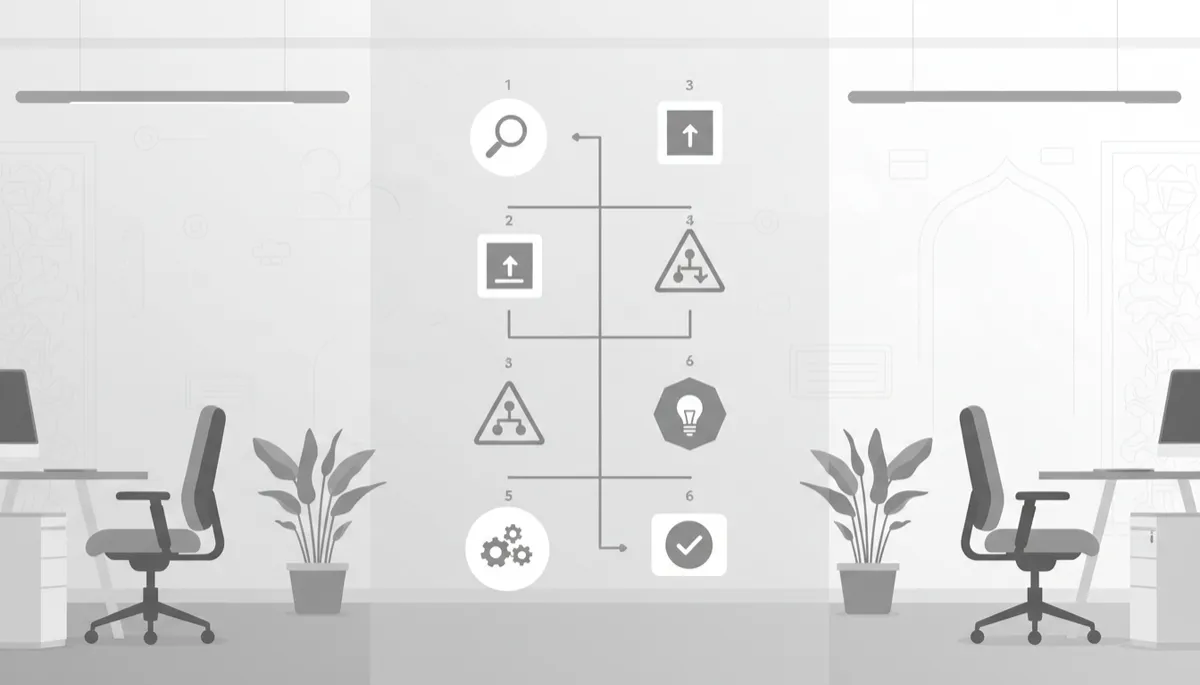
A simple six-step framework turns CRM chaos into a clear buying decision.
Step 1 — Define Your #1 CRM Job First
Before looking at any vendor, write down a single sentence: “The #1 job of our CRM is to …” Then force yourself to finish it with one primary outcome, not five. Examples for Indian SMBs:
- “… capture and follow up every WhatsApp enquiry within 5 minutes.”
- “… keep my sales team accountable with clear daily follow-up tasks.”
- “… automate reminders and nurture for high-ticket service leads.”
This sounds basic, but skipping it is exactly why so many CRM projects drift. The PMC/NIH study on AI-CRM adoption shows that when goals are vague, AI features get underused or misused. The tool ends up collecting data instead of driving behaviour. When your #1 job is clear, every feature demo becomes easier to judge: “Does this help me do that job faster and more reliably, or is it just nice to have?”
Step 2 — Score Each Option Against Your Non-Negotiables
Once your #1 job is clear, define 4–6 non-negotiables. These are not “nice features”; they are the conditions without which the CRM is a waste of time for your business. For Indian SMBs in 2026, the same themes keep showing up in implementation success stories:
- Deep WhatsApp integration: 74% of SMEs say integration with other tools—especially WhatsApp—is their #1 CRM priority. If your leads live on WhatsApp, your CRM must treat it as a core channel, not a side plugin.
- No-code setup: You shouldn’t need a full-time admin or external consultant just to change a pipeline stage or automated follow-up. Non-technical owners and managers should be able to adjust the system themselves.
- AI follow-up and reminders: The AI should nudge your team, not just generate pretty reports. Think: automatic WhatsApp replies, smart follow-up sequences, and daily task lists built from real conversation history.
- Flat-rate or predictable pricing: Per-seat pricing sounds cheap at first, but becomes painful as your team grows. For many SMBs, a flat or predictable plan is the difference between using CRM for everyone vs rationing access.
- India-first support: Time-zone aligned support, understanding of Indian channels like WhatsApp and regional languages, and pricing that accounts for INR realities—not just USD enterprise budgets.
Turn this into a simple 1–5 scorecard for each CRM you evaluate. If a tool fails on even one non-negotiable, it’s out. This is how you cut through the AI CRM comparison guide noise and stop wasting time on “maybe” options that will never really fit your business.
Step 3 — Calculate True Total Cost of Ownership
CRM pricing pages are designed to look harmless. “Just ₹X per user per month.” But once you add implementation, integrations, add-ons, and AI credits, the real first-year cost can be 52–87% higher than the advertised sticker price. That’s not speculation—that’s what owners discover after signing, when it’s already painful to switch.
When you evaluate AI CRM options in 2026, build a simple 12-month cost model for each:
- Licences: Seats, or flat plan. What happens when you add 5 more team members?
- Implementation: Will you pay a partner? How many hours of internal time will it consume?
- Integrations: WhatsApp, telephony, payment links, marketing tools—are these native or paid extras?
- AI usage: Is AI unlimited, or metered by conversations, tokens, or “actions”?
- Training: What will it cost—in time and money—to get your team comfortable?
When you compare total cost of ownership instead of headline price, many “cheap” options suddenly look very expensive. A good AI CRM buyer guide 2026 must force you to run these numbers before you sign anything.
Step 4 — Test for Adoption Speed, Not Just Features
The best predictor of long-term CRM success isn’t how powerful the feature list is; it’s how quickly your real team starts using it without handholding. If your salespeople can’t add a lead, send a WhatsApp, and set a follow-up in under 30 minutes of touching the system, adoption will be a battle forever.
G2’s 2026 analysis of AI CRMs highlights one thing repeatedly: data integration depth and usability drive outcomes more than raw AI capability. A ScienceDirect review of AI in CRM backs this up—AI works only when it sits inside a system your team already uses naturally. That means your evaluation should include a live adoption test:
- Give two or three typical team members access to the trial.
- Ask them to add five leads, send follow-ups, and update deal status.
- Watch, without training, how far they get in 30 minutes.
If they’re lost in menus and settings, that CRM is too complex for your current operations. Remember: every extra layer of complexity can drop adoption by 23%. Your CRM evaluation framework should treat “live in 30 minutes” as a serious benchmark, not a nice surprise.
Step 5 — Verify the AI Is Native, Not Bolted On
By 2026, almost every CRM claims to be “AI-powered.” The question you must ask is: “Is this AI deeply integrated with my data and workflows, or is it just a chatbot on top of a traditional system?”
G2’s 2026 insight is blunt: AI without data context is just an expensive chatbot. The PMC/NIH and ScienceDirect studies on AI in CRM both show that performance jumps when AI is native—meaning it understands your deals, conversations, and pipeline stages natively, not via fragile connectors or exports. In practice, that means:
- AI suggestions appear exactly where your team works (inside WhatsApp threads, lead views, and task lists).
- Follow-up recommendations are based on entire conversation history, not just form fields.
- Automation uses your real business rules—lead source, geography, ticket size—without custom coding.
When you evaluate how to choose AI CRM 2026, demand concrete examples of native AI: “Show me how your AI handles a missed WhatsApp call from a new lead, end-to-end.” If the answer involves three tools and a Zapier-style workflow, that’s bolted-on AI, not native.
Step 6 — Check Onboarding Support and Response Time
Finally, even the best product fails without strong onboarding and support. Salesforce’s State of Sales 2026 notes that teams with structured onboarding and in-context support see far higher CRM usage and AI adoption. For Indian SMBs, this isn’t just about “24×7 chat support”; it’s about real humans who understand local channels, business models, and working hours.
- Ask for typical first-response times for Indian customers during IST business hours.
- Check if onboarding includes done-with-you setup of pipelines, WhatsApp flows, and automation—not just a link to a help centre.
- Confirm whether support is available on channels your team already uses (WhatsApp, email, phone).
Time-zone aligned, India-first support can be the difference between “we went live in a week” and “we’ve been ‘implementing’ for six months.” Your CRM evaluation framework should treat support quality as a core selection criterion, not an afterthought.
The 5 Most Expensive CRM Selection Mistakes to Avoid
Knowing how to choose the right CRM in India also means knowing what to avoid. Across failed implementations, the same five mistakes keep repeating—and they’re all avoidable if you follow a disciplined AI CRM comparison guide.
1. Choosing Brand Prestige Over Operational Fit
Big global brands are impressive, but prestige doesn’t close deals for you. Many Indian SMBs sign up for heavyweight CRMs built for Fortune 500 complexity, then struggle to bend them to simple WhatsApp-led workflows. The result: low adoption, high frustration, and a tool that feels “too heavy” for day-to-day use.
2. Ignoring Per-Seat Pricing at Scale
Per-seat pricing seems harmless when you’re a five-person team. But as you grow to 15, 25, or 40 users, that monthly bill balloons. Owners then start rationing access—“Only sales gets CRM, not support”—which breaks data continuity and kills AI effectiveness. Remember, AI needs complete data across your team to learn and assist properly.
3. Treating WhatsApp as an Afterthought
For Indian businesses, WhatsApp is not “just another channel.” It is often the primary lead source and follow-up channel. Yet many CRMs treat WhatsApp as a third-party plugin or a separate dashboard. That means your conversations, AI, and deals are fragmented. If your AI CRM buyer guide 2026 doesn’t put WhatsApp integration in the top three criteria, it’s outdated for the Indian market.
4. Not Testing Real-World Adoption Before Buying
Owners often attend polished demos, see beautiful dashboards, and sign annual contracts—without ever putting the tool in front of their actual team. Remember that 30–63% failure rate? A big chunk of it comes from this one mistake. If your team cannot run a real day of work in the trial—leads, WhatsApp, follow-ups, closures—don’t sign.
5. Treating AI as a Bonus Feature, Not a Core Workflow
Many buyers still treat AI as “nice to have”—a chatbot here, an email suggestion there. But the 2026 research from Freshworks and others shows that teams who fully embed AI into their daily workflows are the ones seeing 31% shorter cycles and 24% higher quotas. If AI is not helping your team follow up, prioritise, and close daily, you’re underbuying or underusing your CRM.
What to Ask During a Demo Before You Commit
A strong CRM evaluation framework lives or dies in the demo. Here are five sharp questions that cut through marketing language and expose whether a platform will really work for your business in India.
- “Show me a full lead journey starting from WhatsApp.” From first message to follow-up to closure—no slides, just live clicks. This reveals how native the WhatsApp and AI integration truly is.
- “How fast can a non-technical user go live?” Ask them to outline, step by step, how a typical Indian SMB gets to “first live day” with no dedicated admin. If that timeline is more than a week, expect friction.
- “What will my total first-year cost look like?” Push for a breakdown: licences, implementation, integrations, AI usage, training. If they can’t give you a realistic range, the surprise will come later—never in your favour.
- “How do you ensure my team actually adopts the system?” Look for structured onboarding, templates for your type of business, and India-first support. Vague answers like “We have a knowledge base” are not enough.
- “What happens if I double my team size?” This will reveal pricing shocks, performance bottlenecks, and whether the CRM truly scales with your operations.
These five questions will tell you more about a platform than any glossy AI CRM comparison guide or review site. Use them ruthlessly; you’re protecting your team’s time and your own capital.
How RevMax Fits the 2026 AI CRM Decision Framework
Everything in this buyer’s guide is intentional, because RevMax was built specifically around these 2026 realities for Indian SMBs and agencies. It’s not a generic global CRM trying to retrofit India; it’s an India-first AI CRM designed for WhatsApp-led, service-driven businesses that need results fast, not endless configuration.
- WhatsApp AI built-in: RevMax treats WhatsApp as a first-class citizen. Leads flow in, AI replies, follow-ups are scheduled, and your team sees everything in one place—no duct-taped plugins.
- 30-minute setup: The system is designed so a non-technical owner can go from signup to live pipeline in under 30 minutes. That’s not a marketing claim; it’s the benchmark the product is architected around.
- No per-seat fees: RevMax avoids the classic per-user trap, making it practical to give access to everyone involved in revenue—from sales to support—without worrying about every new hire increasing your bill sharply.
- Automation from day one: Instead of giving you a blank canvas, RevMax ships with proven automation templates for follow-ups, reminders, and WhatsApp flows tailored to Indian service businesses. You start optimising from day one, not month six.
- India-first support and strategy: Behind RevMax is the team at Revenue Mastery Consulting, led by Avinash N U, who has worked hands-on with Indian SMBs to fix broken sales systems and CRM rollouts. That experience is baked into the product and onboarding.
If you’ve been wondering how to choose AI CRM 2026 without getting burned, RevMax is intentionally built to sit on the right side of every criterion in this framework. It’s not the right fit for every business on earth—but it’s a strong fit if you’re an India-based agency, coaching business, education company, or service provider relying heavily on WhatsApp and fast follow-up.
You can explore the product and see live workflows in action at whatsapp.studio.revmaxapp.com, where the focus is clear: get you live, fast, with AI doing real work from day one.
Frequently Asked Questions
How long should a CRM evaluation take?
For most Indian SMBs, a focused CRM evaluation should take 2–4 weeks, not six months. Week one: define your #1 CRM job and non-negotiables. Week two: shortlist 2–3 options and run real-world trials with your team. Weeks three and four (if needed): negotiate pricing, check references, and finalise. If a vendor needs months just to show value, expect the implementation to drag as well.
Global brand vs India-first CRM — which is better?
Neither is automatically better. Global brands bring scale and ecosystem; India-first CRMs bring sharper focus on local channels like WhatsApp, Indian payment flows, and INR pricing. For most SMBs, the deciding factor is operational fit, not logo size. If your workflows are simple, WhatsApp-heavy, and team-driven, an India-first AI CRM often delivers faster adoption and ROI than a complex global suite designed for large enterprises.
Native vs bolted-on AI — what’s the difference?
Native AI is built into the heart of the CRM—pipelines, conversations, tasks, and reporting. It sees full context and can act intelligently: suggesting next best actions, drafting WhatsApp replies, prioritising leads, and automating follow-ups. Bolted-on AI is usually a separate assistant or plugin that sits on top of your data with limited context. It looks impressive in a demo but struggles in messy real-world scenarios. For 2026, native AI is what actually moves revenue.
How do I know if my team will actually adopt it?
Don’t guess—test. Put your real team in the trial and watch what happens in the first 30–60 minutes. Can they add leads, send WhatsApp messages, log follow-ups, and see their tasks without training? Do they say, “This is simpler than our current process”? If yes, adoption odds are high. If they look confused or avoid logging in after day two, believe their behaviour, not the sales pitch. Remember, CRM adoption drops sharply with every extra layer of complexity.
What’s the risk of choosing the wrong CRM?
The obvious risk is money—implementation costs that run 52–87% higher than expected, licences you barely use, and add-ons you didn’t plan for. But the bigger risk is opportunity cost. While your team wrestles with a bad fit, faster competitors are using AI CRM to respond quicker, follow up more consistently, and close deals you never saw. Switching later is possible, but it always costs more than choosing correctly once with a clear framework.
Closing Thoughts: The Best AI CRM Is the One Your Team Actually Uses
In 2026, the question isn’t whether you should use an AI CRM. The market data, from Freshworks to Salesforce to academic studies on AI in CRM, makes it clear: teams using AI in their customer systems are moving faster and selling more. The real question is how to choose AI CRM 2026 in a way that fits your business, your channels, and your people.
Use the six-step framework: define your #1 CRM job, lock in non-negotiables, calculate true total cost, test adoption speed, verify native AI, and insist on strong onboarding support. Avoid the five classic mistakes. Ask sharp demo questions. When you do that, the “paradox of choice” disappears. Most tools will disqualify themselves quickly; a small handful will clearly stand out as operational fits.
For Indian SMBs and agencies who live on WhatsApp and care about fast, AI-powered follow-up, RevMax is intentionally built to be that fit. It aligns with every criterion in this CRM evaluation framework: WhatsApp AI built-in, 30-minute setup, no per-seat pricing shocks, and India-first support backed by real revenue strategy experience.
The best AI CRM in 2026 is not the one with the longest feature list; it’s the one your team adopts in week one and that delivers visible revenue impact in the first 30 days. If that’s the outcome you’re aiming for, start by seeing how quickly you can get live with RevMax.
Direct CTA:Start with RevMax — live in 30 minutes. Let your next 30 days prove whether your CRM is finally working for you, not against you.
References & Links
- Freshworks 2024 CRM Survey & Statistics: https://www.freshworks.com/theworks/company-news/crm-statistics/
- Salesforce State of Sales 2026: https://www.salesforce.com/resources/research-reports/state-of-sales/
- PMC/NIH AI-CRM Study: https://pmc.ncbi.nlm.nih.gov/articles/PMC11382090/
- ScienceDirect AI in CRM Research: https://www.sciencedirect.com/science/article/pii/S2444569X25000769
- Revenue Mastery Consulting: https://revenuemasteryconsulting.com/
- RevMax Website: https://revmaxapp.com/
- RevMax WhatsApp Studio: https://whatsapp.studio.revmaxapp.com/