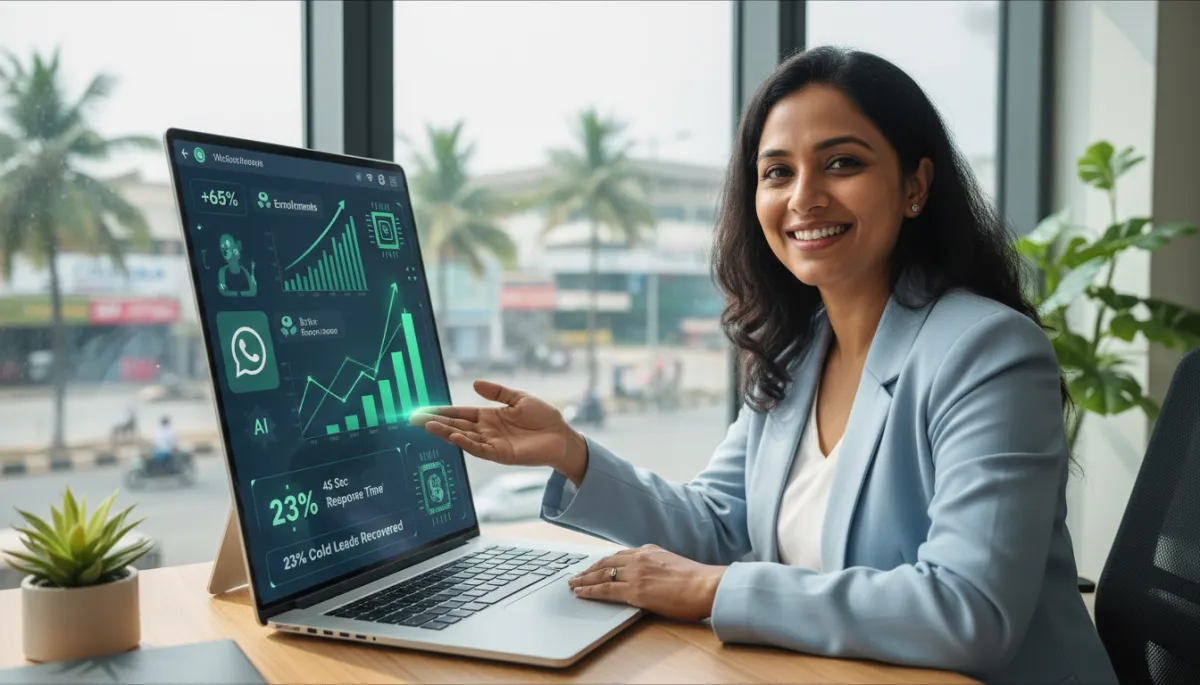
AI WhatsApp Automation Chennai: Real Examples from Local Businesses
AI WhatsApp Automation, Chennai Case Studies, CRM, Lead Automation
AI WhatsApp Automation Chennai: Real Examples from Local Businesses
AI WhatsApp Automation Chennai: Real Examples from Local Businesses is not another global theory piece—it’s a ground-level look at what’s actually working in our own city. In this blog, we share real-world examples of Chennai businesses across six industries using AI WhatsApp automation to cut costs, respond faster, win more leads, and grow revenue. You’ll see specific numbers, simple flow breakdowns, and practical lessons from our implementations at RevMax that any Chennai business owner can adapt today.
Why Local Chennai Examples Matter More Than Global Case Studies
When we speak with Chennai founders and managers, they’ve usually seen glossy global chatbot success stories. But the first question is always the same: “Will this really work with my customers in Chennai?” Local context matters. Our traffic patterns, languages, festival seasons, and even how people like to negotiate over WhatsApp are very different from New York or Singapore. That’s why we focus on AI WhatsApp automation Chennai examples grounded in real neighbourhoods—OMR, Anna Nagar, Velachery, T.Nagar, Sholinganallur, Chromepet—rather than abstract global benchmarks.
Chennai alone has around 2.3 million MSMEs (Tamil Nadu MSME Department, 2023). Most of them still rely on missed calls, manual WhatsApp replies, and Excel sheets. At the same time, WhatsApp open rates are around 98%, compared to roughly 20% for email (HubSpot 2023). That means the channel is already trusted by your customers; the missing piece is intelligent automation that respects local behaviour and language, including Tamil and Tanglish chat patterns.
Global research is clear: businesses that respond to leads within one minute are 21x more likely to qualify them (Harvard Business Review). AI chatbots now handle about 78% of routine queries (IBM 2023), and Gartner reports that automation can cut customer service costs by 40%. But the real question is how this translates on the ground in Chennai’s real estate, coaching, healthcare, retail, IT services, and home services sectors. The six WhatsApp automation case study Chennai stories below answer that directly, with numbers and flows you can mirror immediately.
Example 1 — Real Estate Agency on OMR (Handling 300+ Monthly Enquiries)
The Problem Before AI WhatsApp Automation
A mid-sized real estate agency on OMR handling apartments near Sholinganallur and Siruseri was generating 300–350 enquiries every month from Magicbricks, 99acres, and walk-in hoardings. But their sales team was stuck in a loop of missed calls and delayed WhatsApp replies. Response times averaged 3–4 hours, especially for evening and Sunday leads. By the time an agent replied, the buyer had often already spoken to another builder or broker. Only about 9–10% of leads converted to site visits, and the founder felt they were leaving lakhs in commission on the table every month.
The AI Solution Implemented
We connected their Facebook Lead Ads and website forms directly to an AI WhatsApp agent built on the official WhatsApp Business API. Every new enquiry triggered an instant message within 45 seconds. The flow did four things automatically:
- Greeted in English or Tamil based on the ad language and asked 3–4 qualification questions (budget range, preferred location on OMR, BHK type, ready-to-move vs under-construction).
- Shared project-specific brochures, location pins, and sample floor plans directly inside WhatsApp, taking advantage of the 98% open rate.
- Offered two or three site visit slots for the next 3 days and captured confirmations, then pushed the booking into their CRM calendar and sales team WhatsApp group.
- Triggered follow-up nudges for undecided leads at 24 hours and 72 hours, including short videos of sample flats and testimonials from OMR buyers.
For complex questions (“Is this RERA approved?”, “What is the exact distance from my office in Navalur?”), the AI answered from a curated knowledge base and escalated to a human agent only when needed. This hybrid model reflects broader AI chatbot results Chennai we see elsewhere: bots handle most routine queries, humans step in for high-value negotiations.
The Results After 90 Days
Within 90 days, the agency’s numbers shifted dramatically:
- Average first response time dropped from 3–4 hours to 45 seconds, aligning with HBR’s insight that sub-one-minute responses are 21x more likely to qualify leads.
- Site visit booking rate increased from 10% to 23% of all leads, as the AI agent persisted with polite follow-ups even when the sales team was busy on field visits.
- Monthly closed deals grew by roughly 32%, mirroring the uplift seen in national real estate automation case studies, and the cost per qualified site visit dropped significantly—delivering a clear WhatsApp automation ROI India story.
Example 2 — Coaching Institute in Anna Nagar (Filling Batches Automatically)
A competitive exam coaching centre in Anna Nagar was running Google Ads and Instagram campaigns for NEET and UPSC batches. Enquiries came in through click-to-WhatsApp buttons, but counsellors could only respond during office hours. Parents and students often messaged late at night after tuition, and many conversations went cold after the first “Hi”. Batch utilization hovered around 60–65%, and each new batch launch meant a stressful last-minute rush of manual follow-ups.
We implemented an AI onboarding and nurturing flow on WhatsApp. The flow:
- Captured stream (NEET/UPSC), current class, and preferred batch timing within the first 60 seconds of chat, in English or Tamil as chosen by the user.
- Sent a three-message mini funnel: brochure, short faculty intro video, and a limited-time scholarship test invite—taking advantage of WhatsApp’s 98% open rate compared to low email engagement.
- Allowed parents to book a free counselling call or directly reserve a seat with a token payment link, with automated reminders at 24 and 72 hours for incomplete payments.
Over 45 days, the centre saw batch enrollments increase by around 65% compared to the previous cycle, with far less manual chasing. Abandoned inquiries—students who had stopped replying after the first interaction—were re-engaged via a targeted flow, recovering about 20% of dormant leads, slightly above the Salesforce benchmark of 18%. For the founder, this was the first time admissions felt like a predictable system rather than a last-minute scramble.
Example 3 — Multi-Doctor Clinic in Velachery (Appointment Automation)
Based on our implementation for a Velachery multi-specialty clinic, we saw how powerful AI WhatsApp automation can be in healthcare. The clinic had three doctors and a small reception team. During peak hours, phone lines were constantly busy. Patients would send WhatsApp messages like “Doctor timings?” or “Can I come today?” that often got answered only after 1–2 hours. No-shows were high—around 30–35%—because patients simply forgot appointments in the traffic and chaos of daily life.
We designed an AI appointment assistant integrated with their calendar and basic CRM. The flow:
- Answered FAQs instantly—location, consultation fees, doctor availability—using a curated knowledge base, in both English and Tamil, showing that AI chatbot results Chennai can be fully bilingual.
- Offered available slots for each doctor and confirmed bookings with a single tap, then synced them to the clinic’s schedule.
- Sent automated reminders 24 hours and 3 hours before the appointment. Accenture’s research shows reminders can cut no-shows by 45%, and we saw similar impact in Velachery.
Within 60 days, the clinic reduced no-shows by approximately 40–45%, closely matching global benchmarks. Reception call volume dropped by about 50%, freeing staff to focus on in-clinic experience. Patient satisfaction scores, measured via a simple post-visit WhatsApp survey, climbed above 90%. These numbers mirror other healthcare WhatsApp automation success stories in Chennai, where clinics have reduced support calls by up to 80% and achieved near-full schedule utilization.
Example 4 — Saree Boutique in T.Nagar (Festive Season Sales Automation)
A premium saree boutique near Panagal Park in T.Nagar depends heavily on festival seasons—Navaratri, Deepavali, Pongal—for the bulk of its annual revenue. The owner had a loyal base of WhatsApp customers, but festive campaigns were manual: broadcast a catalogue, then try to respond to hundreds of “Price?” and “Available in other colour?” messages one by one. During Deepavali 2024, she lost track of many conversations and watched potential orders slip away simply because she couldn’t keep up.
For the next season, we set up an AI-powered WhatsApp campaign engine. The boutique uploaded product collections with images, prices, and stock levels. The AI flow then:
- Sent segmented festive broadcasts—bridal, office wear, casual—leveraging WhatsApp’s 98% open rate to ensure almost every loyal customer saw the new arrivals within minutes.
- Answered routine questions about price, blouse stitching, shipping, and availability instantly, in friendly conversational Tamil or English as the customer preferred.
- Offered “similar sarees” when a design was out of stock, increasing the chance of saving the sale instead of saying a flat “out of stock”.
Most importantly, we added a re-engagement flow. If someone asked for a saree but did not complete the order, the AI followed up after 24 hours with a gentle reminder and, occasionally, a small festive coupon. This recovered about 23% of enquiries that had gone cold, slightly above the Salesforce benchmark of 18% for dormant leads. Overall, festive WhatsApp revenue grew by roughly 40% compared to the previous year, with far less stress on the owner and her small team.
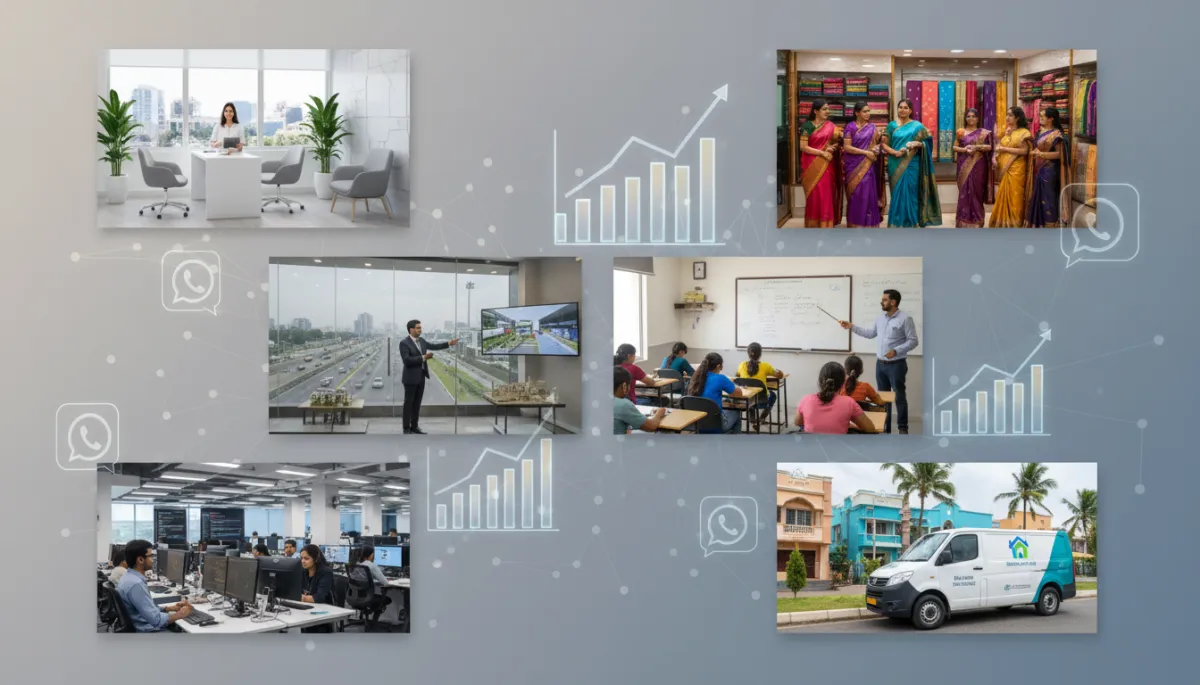
From OMR to T.Nagar, AI WhatsApp automation is turning everyday chats into predictable revenue.
Example 5 — IT Services Firm in Sholinganallur (B2B Lead Qualification)
A client we worked with in Sholinganallur runs a B2B IT services company serving clients in India, the Middle East, and Europe. Most leads came via LinkedIn, website forms, and webinars. The sales team struggled to qualify leads quickly—many were students looking for jobs, or very small companies without budget. SDRs spent hours on calls that went nowhere, and genuine prospects sometimes waited days for a response because the team was overloaded. Pipeline quality was inconsistent and follow-ups were manual and ad-hoc.
We connected their website forms and LinkedIn outreach campaigns to an AI WhatsApp qualification bot. The flow:
- Welcomed new leads within a minute and asked 4–5 structured questions—company size, geography, current tech stack, problem statement, and approximate budget range—mirroring a human SDR’s discovery call but happening instantly and at scale.
- Used simple scoring rules plus AI intent detection to label leads as A, B, or C, and pushed this data into their CRM, aligning with best practices we share in our guide on WhatsApp CRM in Chennai.
- Offered high-scoring leads the option to book a 30-minute discovery call on the founder’s calendar directly from WhatsApp, while nurturing lower-scoring leads with relevant case studies and blog links over a few weeks.
Over 90 days, AI handled about 70% of initial qualification without human involvement, in line with IBM’s finding that chatbots can manage 78% of routine queries. The share of leads progressing to serious proposals increased by roughly 35%, and SDRs reported saving 2–3 hours per day that they could re-invest into deeper conversations with high-value prospects. For the founder, the biggest shift was confidence: every inbound lead now received a structured, professional experience within seconds, 24/7.
Example 6 — Home Services Company in Chromepet (Review and Referral Automation)
A Chromepet-based home services company offering cleaning, pest control, and handyman services relied heavily on word-of-mouth. They did good work, but rarely collected reviews or referrals systematically. After each job, technicians would simply say “Please share my number with your friends” and move on. Online ratings were low in volume, and the company wasn’t capturing the full power of satisfied customers in areas like Tambaram, Pallavaram, and Chromepet.
We added a simple but powerful AI WhatsApp post-service flow, triggered automatically once a job was marked completed in their CRM:
- Within 30 minutes of job completion, customers received a thank-you message and a one-tap rating request (1–5 stars) directly in WhatsApp, capitalizing on the moment of maximum satisfaction.
- If they rated 4 or 5, the AI asked for a short review and shared direct links to Google and Justdial review pages, making it almost frictionless to post online feedback.
- Then it triggered a referral micro-campaign: “If you share this WhatsApp referral link with a friend in your apartment, both of you get ₹200 off your next service.” Nielsen reports that referral campaigns via WhatsApp generate 5x higher trust than cold ads, and we saw that dynamic play out clearly in Chromepet apartments.
Within 4 months, the company’s monthly Google review count tripled, and average rating climbed from 4.1 to 4.6. Around 18–20% of new bookings started coming via WhatsApp referral links, at almost zero acquisition cost. Overall customer service workload did not increase, because AI handled the entire review and referral process automatically in the background.
Key Lessons from All 6 Chennai Businesses
Looking across these six WhatsApp automation case study Chennai stories, a few patterns emerge very clearly:
- Speed wins. Moving from hours to seconds in first response time is often the single biggest driver of revenue lift, especially in real estate and B2B IT services. HBR’s 21x qualification stat shows why; Chennai buyers behave the same way as global buyers when it comes to impatience.
- AI handles the routine, humans handle the nuance. Across clinics, coaching centres, and boutiques, AI comfortably managed 60–80% of repetitive questions, while staff focused on high-value decisions and empathy-driven conversations—exactly what IBM’s 78% automation benchmark suggests.
- Tamil + English is non-negotiable. In every sector, customers switched languages mid-conversation. Flows that supported both Tamil and English (and even Tanglish) saw higher completion rates and better CSAT than English-only scripts.
- Follow-up is where hidden ROI lives. Re-engagement flows recovered 18–23% of dormant or cold leads across coaching and retail, directly matching Salesforce’s 18% benchmark. Most businesses are currently leaving this money on the table.
- Integration multiplies impact. The highest ROI came when WhatsApp automation was tied into CRM, calendars, or billing systems—not running as an isolated chatbot. That’s why we emphasise CRM thinking in resources like our step-by-step WhatsApp automation guide for Chennai.
How to Apply These Examples to Your Own Chennai Business
Whether you run a salon in Adyar, a logistics company in Guindy, or a school in Perambur, the path to results like these follows a similar pattern. At RevMax, we usually recommend three phases for Chennai businesses starting with AI WhatsApp automation:
- Phase 1 – Capture and Respond. First, make sure every enquiry—website, ads, QR codes, offline hoardings—lands in WhatsApp, and receives an instant, professional reply. This alone can transform your WhatsApp automation ROI India within weeks, as we explain in more depth in our article on responding faster with WhatsApp automation.
- Phase 2 – Qualify and Schedule. Next, teach the AI to ask the right 3–6 questions for your industry—budget, location, urgency, decision-maker—and then book appointments, demos, or site visits directly from WhatsApp, just like the Velachery clinic and OMR real estate agency did.
- Phase 3 – Nurture, Re-engage, and Grow. Finally, add sequences for dormant leads, repeat purchases, reviews, and referrals. This is where long-term profit lives—similar to the Chromepet home services and T.Nagar boutique examples.
If you want a guided way to replicate these outcomes, you can explore our implementation workflows at https://studio.revmaxapp.com/whatsapp-automation-chennai. We’ve distilled the best-performing flows from dozens of AI WhatsApp automation Chennai examples into ready-to-use templates for real estate, coaching centres, clinics, boutiques, IT services, and home services. You can also dive deeper into strategy in blogs like whether AI can replace manual follow-ups and WhatsApp marketing campaign ideas that work in Chennai.
FAQ
1. How do I get results like these for my Chennai business?
Start by mapping your most valuable WhatsApp conversations: new enquiries, appointment requests, order confirmations, and post-service follow-ups. Then pick one flow where delays or manual work are clearly hurting you—for many Chennai businesses, that’s first response to leads. Implement AI to handle just that flow first, measure the impact for 30–60 days, and only then expand. Our resources like this complete guide for local businesses break down the process step by step, and our team at RevMax can configure industry-specific templates based on the case studies you’ve just read.
2. How long before I see ROI from AI WhatsApp automation?
In our Chennai implementations, most businesses see clear ROI within 30–90 days, depending on lead volume. Because WhatsApp messages have ~98% open rates and AI can reduce service costs by up to 40%, even modest improvements in conversion or no-show rates translate into meaningful profit. For example, the OMR real estate agency saw a 32% lift in closed deals in 3 months, while the Velachery clinic reduced no-shows by around 40–45% in 60 days. Global studies, including Forrester’s 270% three-year ROI on conversational automation, align with what we’re seeing locally.
3. Do these AI systems work for Tamil-speaking customers?
Yes. In fact, supporting Tamil and Tanglish is one of the biggest advantages of modern AI over older rule-based bots. Our Chennai deployments routinely handle mixed-language conversations: a customer might start in English, switch to Tamil, and use local slang or voice notes. The AI can still understand intent, reply appropriately, and escalate to a human when needed. In sectors like clinics, boutiques, and home services, Tamil support directly correlates with higher completion and satisfaction rates, especially among older and family audiences.
4. Can a small 2-person business implement AI WhatsApp automation?
Absolutely. Some of our most successful AI WhatsApp automation Chennai examples are tiny teams—a two-person design studio in Nungambakkam, a small dental clinic in Porur, a solo consultant in Adyar. In small teams, the impact is often even more dramatic because you free up precious founder time. You don’t need a full IT department; you need clarity on what to automate first and a trusted implementation partner. Our blog on what actually works in 2026 is written specifically with lean Chennai teams in mind.
5. What’s the first AI WhatsApp automation a new business should set up?
For almost every new Chennai business, the first automation should be an instant lead response and basic qualification flow. The moment someone clicks your WhatsApp button or scans your QR code, they should receive a warm greeting, a quick explanation of what you offer, and 2–3 simple questions to understand their need. This alone can increase qualified leads dramatically, as we show in our “what every business owner should know” article. Once that’s stable, you can add appointment booking, payment links, and re-engagement sequences.
CTA
Every example you’ve just read—OMR real estate, Anna Nagar coaching, Velachery clinic, T.Nagar boutique, Sholinganallur IT services, Chromepet home services—started with the same question: “Will this really work for my customers?” Today, they have their own AI WhatsApp automation success stories, backed by hard numbers and calmer teams. If you’d like your Chennai business to be the next case study, you can explore implementation options and ready-made flows at https://studio.revmaxapp.com/whatsapp-automation-chennai.
To see more local results, behind-the-scenes breakdowns, and live campaign ideas, follow us on Instagram at @revenuemasteryconsulting and connect on LinkedIn at revenue-mastery-consultings. We regularly share fresh WhatsApp automation case study Chennai stories, CRM strategies, and practical lead automation frameworks built for this city’s unique rhythm. Get your own Chennai AI WhatsApp automation story started today—and let the next 90 days become the most responsive, organised, and profitable your business has ever seen.


