AI WhatsApp Automation Chennai: Can It Replace Manual Follow-Ups?
AI WhatsApp Automation, Chennai Business Growth, Lead Follow-Ups
AI WhatsApp Automation Chennai: Can It Replace Manual Follow-Ups?
AI WhatsApp Automation Chennai: Can It Replace Manual Follow-Ups? That’s the question almost every serious Chennai business owner is asking in 2026. This blog gives Chennai founders, marketing heads, and sales leaders an honest, research-backed answer to whether AI-powered WhatsApp automation can fully replace manual follow-ups — and where the human touch still matters. By the end, you’ll know exactly what to automate, what to keep human, and how top local businesses are already doing it.
The Manual Follow-Up Burden Chennai Businesses Carry Every Day
If you run a business in Chennai, you already know the story. Leads come in from Meta ads, Justdial, Google, walk-ins, referrals — and by the time your team finishes the day, half of them have not been followed up properly on WhatsApp. According to McKinsey 2023, Chennai SMEs spend an average of 2.5 hours per day on manual follow-ups alone. That’s time your sales team could spend actually closing deals or nurturing serious prospects instead of copying-pasting messages and chasing “Hi, still interested?” replies.
The reality is harsh: people expect instant replies. Salesforce 2023 reports that 67% of customers prefer messaging over calling, and when they message, they expect a response in minutes, not hours. But in most Chennai businesses we speak to — from OMR real estate projects to Anna Nagar coaching institutes and Velachery clinics — the pattern is the same: leads pile up during peak hours, and responses get delayed to “after lunch” or “tonight when I get free.” Many never get a second or third follow-up at all.
Over a month, that delay quietly kills revenue. Leads go cold, competitors respond faster, and your team gets blamed for “weak follow-up” even though they’re actually overloaded. This is the exact pain AI WhatsApp automation in Chennai is trying to solve — not by replacing your people, but by removing the repetitive, low-value follow-up work that drains them every day.
What AI WhatsApp Automation Actually Does (Plain English)
Before we ask whether it can replace manual follow-ups, we need to be clear on what AI WhatsApp automation actually is — and what it is not. In plain English, AI WhatsApp automation means:
- Using an AI chatbot on WhatsApp to reply to leads and customers automatically, based on rules, training data, and your business logic.
- Connecting WhatsApp to your CRM, booking tools, payment links, and calendars so the AI can share details, capture data, and schedule appointments without a human typing each message.
- Setting up follow-up workflows — for example: Day 0: instant greeting, Day 1: reminder, Day 3: final nudge — that run automatically for each new lead, at scale.
Globally, AI chatbots now handle about 78% of routine queries without human help (IBM 2023). On WhatsApp, that means answering FAQs, sharing brochures, giving price ranges, checking slot availability, and pre-qualifying leads — all before a human ever steps in. In India, and particularly in Chennai, this is now moving from “nice to have” to standard practice, especially in sectors like real estate, education, healthcare, and local services.
Importantly, Meta’s 2026 policies do not allow vague, general-purpose chatbots on the WhatsApp Business API anymore. AI must be task-specific — for example, “qualify a lead,” “book an appointment,” “answer policy questions.” Platforms like RevMax Studio for WhatsApp Automation Chennai are built around these structured workflows, so you stay compliant while still getting the benefits of AI-driven follow-up.
Where AI WhatsApp Automation Beats Manual Follow-Ups
Speed — Responding in Seconds, Not Hours
In a city as competitive as Chennai, speed is often the difference between a closed deal and a lost lead. McKinsey 2023 found that businesses using AI follow-ups see 40% faster response times than those relying only on humans. AI WhatsApp automation can reply within seconds — whether the lead comes in at 11:00 a.m. during office rush or 11:30 p.m. after your team has logged off.
For our RevMax clients — such as real estate agents along OMR — we’ve seen first response times drop from 2–3 hours to under 30 seconds. The AI shares project details, asks qualifying questions (budget, preferred location, timeline), and only then alerts a human when a lead looks serious. By the time your sales rep calls, the lead is already warmed up and expects the call, instead of wondering, “Who is this?”
Scale — Following Up With 500 Leads Simultaneously
A human follow-up executive can handle maybe 40–60 meaningful WhatsApp conversations per day without burning out. But your ad campaigns don’t care about that limit. On a good campaign weekend, you might generate 300–600 leads. Without automation, your team simply cannot follow up with everyone properly, and the overflow silently dies in your spreadsheet or CRM.
With AI chatbot WhatsApp Chennai solutions, you can run parallel follow-up flows for hundreds of leads at once. Each lead gets:
- An instant welcome message and basic info.
- A set of 2–3 qualification questions tailored to your sector.
- Automated reminders if they don’t respond the first time.
Our clients report that AI-powered follow-ups increase lead conversion by about 28% compared to purely manual follow-ups (Forrester 2024) because fewer leads are left untouched. When you combine this with integrated CRM workflows — like those we describe in this guide on WhatsApp CRM Chennai — you get a system that doesn’t forget or get tired, even on your busiest days.
Consistency — Never Missing a Follow-Up Again
Humans are inconsistent by nature. Some days they’re energetic, some days they’re sick, some days they’re simply overwhelmed. AI, on the other hand, is ruthlessly consistent. Once you define your WhatsApp AI follow-up India workflow — first message, reminder, final nudge, handoff rules — the system executes it exactly the same way for every single lead, every single time.
Gartner 2023 notes that once AI filters conversations, human agents are needed for only about 22% of complex queries. That means 78% of the noise — “What’s the fee?”, “Where are you located?”, “Is parking available?” — can be handled by automation, freeing your team to focus on the 22% that truly need human attention. For a coaching institute in Anna Nagar working with RevMax, this shift alone cut manual follow-up workload by more than half while actually improving student experience, because nobody was left waiting for basic information.
24/7 Availability — Working While You Sleep
Leads don’t only come between 10 a.m. and 7 p.m. People browse properties at midnight, search for dermatologists after dinner, and look for coaching centres on Sunday afternoons. AI WhatsApp automation gives you a polite, always-on front desk that never complains about working late or on weekends. Studies show that businesses offering 24/7 automated WhatsApp availability see around a 40% increase in customer-initiated conversations compared to limited-hours support.
For a clinic in Velachery using RevMax, late-night appointment enquiries were previously answered the next morning — by which time many patients had already booked elsewhere. With an AI agent handling first contact and basic triage, more than half of those late-night leads now convert into confirmed appointments, with human staff stepping in only when needed. This is exactly the kind of “working while you sleep” advantage that AI WhatsApp automation Chennai can unlock.
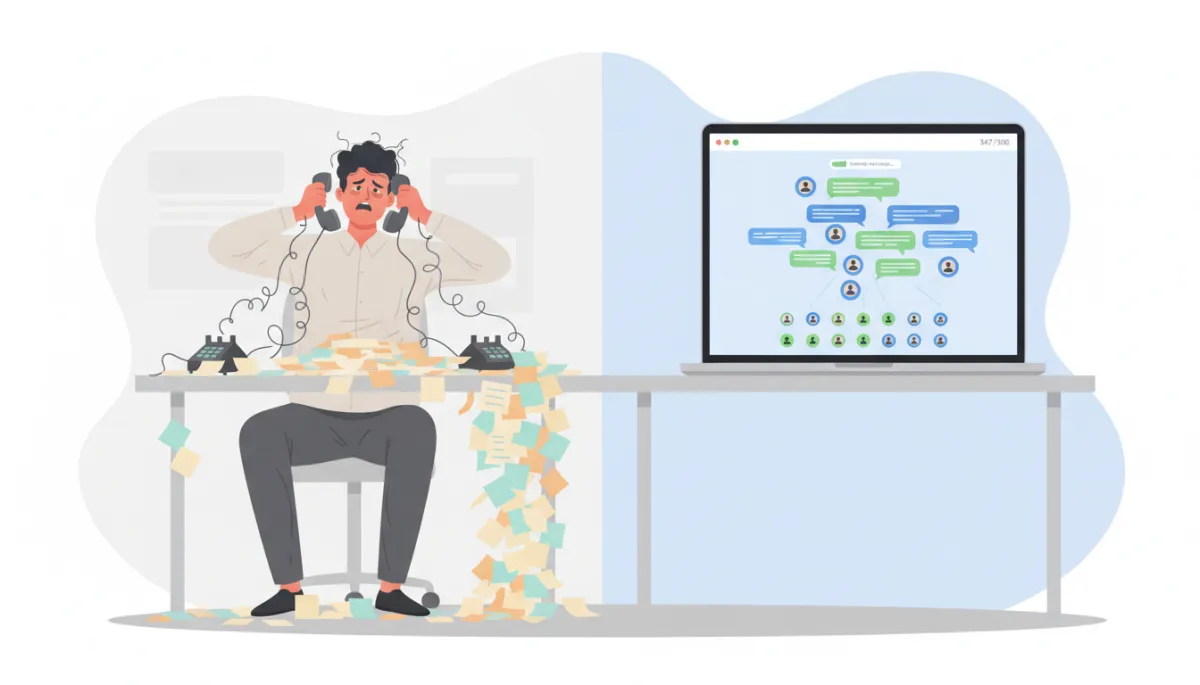
Moving routine follow-ups to AI frees your team to focus on real conversations.
Where Manual Follow-Ups Still Win
High-Value, High-Emotion Decisions
Let’s be clear: AI is not here to close a ₹1.5 crore apartment sale on its own. When stakes are high and emotions are strong — buying property, choosing a surgery, picking a career-defining course — people want to talk to humans. They want to sense confidence, empathy, and trust in the person on the other side. No matter how advanced your AI chatbot WhatsApp Chennai setup is, this is not something you should automate away in 2026.
What AI can do is prepare that conversation. It can answer early questions, share brochures, collect documents, and schedule site visits or consultations. But when it comes to final decision-making, you still need your best closers, counsellors, or doctors to step in. Our experience at RevMax with OMR real estate clients confirms this: the highest-converting flows are those where AI warms up and qualifies leads, and humans handle the last few, critical steps.
Complex Objection Handling
AI is excellent at answering known, well-documented objections — like EMI options, refund policies, or what’s included in a package. But when a prospect raises a complex, multi-layered objection (“I like the project, but my parents are worried about the location, and my bank is delaying approval”), the nuance required is still best handled by an experienced human who can read tone, ask probing questions, and adapt on the fly.
That’s why we recommend designing your WhatsApp AI follow-up India flows with clear escalation rules. The moment the AI detects confusion, frustration, or repeated objections it cannot resolve, it should gracefully hand over to a human with full context — not keep looping canned answers. We’ll cover how to set up these “human handoff” triggers later in this article.
Relationship-Based Selling (Real Estate, B2B, Healthcare)
Certain categories in Chennai — especially real estate, B2B services, and healthcare — lean heavily on long-term relationships. Here, manual follow-ups still have a major edge. A senior sales manager checking in personally after a site visit, a doctor’s assistant following up post-surgery, or a B2B founder sending a voice note — these touches build trust in ways AI can’t fully replicate yet.
Our clients in these sectors use AI to handle the volume of early-stage interactions, but intentionally switch to human-led, personalised communication once a lead crosses a certain value or stage. If you’re in one of these relationship-heavy categories, your goal shouldn’t be to replace manual follow-ups with AI, but to protect your team’s time so they can invest more energy into the conversations that truly matter. For more on this balance, see our deep dive: WhatsApp Business Automation Chennai: What Actually Works in 2026.
The Hybrid Model — What Top Chennai Businesses Are Doing in 2026
Across our work with Chennai businesses, one pattern is crystal clear: the winners in 2026 are not choosing between AI and humans. They are building hybrid systems where AI handles routine, repetitive follow-ups and humans step in for high-value, nuanced conversations. This aligns with global best practices, where AI agents handle 60–80% of conversations end-to-end, and only 20–40% require escalation to people.
- OMR real estate developers use AI to respond instantly to portal leads, share project details, qualify budget and timeline, and then auto-book site visits into the sales team’s calendar. Human agents focus on site tours and closing, not chasing first responses.
- Coaching institutes in Anna Nagar run AI-led follow-ups for demo class registrations, fee queries, and batch timings. Counsellors only step in once a student shows serious intent or a parent requests a call.
- Clinics in Velachery use AI to handle appointment scheduling, reminders, and basic procedure FAQs. Human staff focus on clinical coordination and sensitive conversations.
This hybrid approach is also what Meta encourages with its policy shift away from general-purpose bots. AI is a workflow engine, not a replacement for your brand’s human voice. For a full breakdown of how hybrid flows look in practice, explore how Chennai businesses use WhatsApp automation to respond faster and real examples from local businesses using AI WhatsApp automation Chennai.
How to Set Up AI Follow-Ups That Feel Human
One of the biggest fears Chennai business owners share with us is: “I don’t want my customers to feel like they’re talking to a robot.” That fear is valid — poorly designed automation can feel cold and transactional. But done right, AI follow-ups can actually feel more human than rushed manual replies, because they’re timely, thoughtful, and consistent in tone. Here’s how to achieve that:
- Write like a person, not a bot. Use simple, conversational language. Short sentences. Occasional local references (“We’re right next to Phoenix Marketcity”). Avoid over-formal, template-style messages that scream automation.
- Personalise with real data. Salesforce 2024 found that personalised AI messages get 47% higher response rates. Use the lead’s name, reference their enquiry source, and adapt content based on their answers. “Hi Priya, saw that you enquired about our NEET batch starting in July…” feels very different from a generic “Dear Student.”
- Be transparent but friendly. You don’t have to hide that it’s AI, but you also don’t need to over-emphasise it. A simple line like “I’m the assistant for Dr. Kumar’s clinic here to help you with quick questions” keeps expectations clear without sounding robotic.
- Design smart handoff triggers. Set rules so that when a conversation becomes emotional, complex, or high-value, the AI offers: “Would you like to speak to a person? I can connect you now or schedule a call.” Then route that to a human with full chat history visible in your CRM or RevMax dashboard.
- Test with real customers. Before scaling, run your flows with a small group and ask them honestly: “Did this feel robotic? Where did you feel stuck?” Use that feedback to refine tone, timing, and escalation rules. Our article AI WhatsApp Automation Chennai: What Every Business Owner Should Know walks through this testing process step-by-step.
Real Numbers: What Changes When You Switch to AI Follow-Ups
Let’s move from theory to numbers. Across global and India-specific studies — and our own RevMax client data — a few patterns emerge when businesses replace a big chunk of manual follow-ups with AI WhatsApp automation:
- First response time: Drops from hours to seconds. AI agents typically respond in under 30 seconds, compared to 4–12 hours for purely manual systems (industry benchmarks for WhatsApp Business automation in 2026).
- Lead conversion: AI-powered follow-ups deliver around a 28% lift in lead conversion vs manual-only follow-ups (Forrester 2024), mainly because they reach more leads faster and with more consistency.
- Routine query handling: AI chatbots successfully resolve about 78% of routine queries (IBM 2023). Human agents then focus on the remaining 22% of complex cases (Gartner 2023).
- Team workload: Chennai SMEs that adopt structured AI workflows typically free 1–2 hours per day per salesperson, based on our RevMax implementations and the McKinsey estimate of 2.5 hours spent daily on manual follow-ups.
Combine this with WhatsApp’s 98% open rate and the fact that more than 200 million businesses globally now use WhatsApp Business, and the case becomes clear: if you’re still depending entirely on manual follow-ups in 2026, you’re competing with businesses that respond faster, nurture more leads, and do it at lower cost. To see how this plays out across different sectors, check our piece on 7 ways Chennai businesses save hours every week with WhatsApp automation.
When our own clients plug into RevMax’s WhatsApp automation studio for Chennai, they typically see results within the first 30–60 days: faster responses, more appointments booked, fewer “sorry, I missed this” messages, and a calmer, more focused sales team. The numbers don’t lie — but they only work if you implement AI thoughtfully, with a clear hybrid strategy instead of chasing “full replacement.”
FAQ
1. Can AI automation handle complex customer objections?
AI can handle structured, well-documented objections very effectively — for example, EMI options, refund rules, timelines, or what’s included in a package. It struggles when objections are emotional, multi-layered, or require negotiation. That’s why the best systems use AI to answer 70–80% of standard questions and then escalate the remaining 20–30% to a human with all context visible. This keeps your team focused on conversations where they truly add value, rather than repeating the same answers all day. Our detailed guide on AI WhatsApp Automation Chennai explains how to design these objection flows safely.
2. Will customers know they are talking to AI?
In most cases, yes — and that’s okay. The goal is not to “trick” people, but to provide fast, clear, respectful help. When your AI is designed with a human tone, personalisation, and easy access to a real person, customers rarely complain that it’s automated. In fact, many prefer it because they get instant answers. The problem only arises when bots are rigid, unhelpful, or refuse to connect to a human. If you follow the principles we outlined earlier — friendly tone, personalisation, and clear handoff options — customers will care more about speed and clarity than whether it’s AI or a person typing.
3. How do I set up a human handoff trigger?
A good human handoff system has three components: triggers, routing, and context. Triggers can be keywords (“talk to human”, “call me”), repeated negative sentiment (“not happy”, “confused”), or reaching a certain deal size or lead score. Routing decides which team member gets the chat — sales, support, or a specific relationship manager. Context means the human sees the full AI conversation, lead data, and tags when they join, so they don’t ask the customer to repeat everything. Platforms like RevMax make this configuration straightforward, and we cover the logic in more depth in our complete WhatsApp automation guide for Chennai businesses.
4. What types of businesses should NOT fully replace manual follow-ups?
Any business where trust, emotion, or complexity is central to the buying decision should avoid trying to completely replace manual follow-ups with AI. This includes high-ticket real estate, specialised healthcare, legal and financial advisory, and long-term B2B contracts. In these cases, AI should handle first contact, FAQs, scheduling, and reminders — but humans should lead serious consultations, negotiations, and final decisions. Even in more transactional sectors, we advise keeping a human layer ready for escalations instead of going 100% automated. Think of AI as your first line of engagement, not your entire follow-up strategy.
5. How much does AI WhatsApp automation cost vs hiring a follow-up person?
Costs vary by platform and volume, but in Chennai we typically see AI WhatsApp automation plans starting from a fraction of one full-time salary — often less than the monthly cost of hiring and training even a junior follow-up executive. When you factor in that AI can handle hundreds of parallel conversations, work 24/7, and never take leave, the cost per conversation becomes significantly lower than a purely human team. That doesn’t mean you should fire your staff; it means you can reassign them to higher-value work like closing, upselling, and relationship building while AI handles the heavy lifting of routine follow-ups.
CTA
So, can AI WhatsApp automation Chennai completely replace manual follow-ups? In 2026, the honest answer is: no — and it shouldn’t. But it can replace the slow, repetitive, low-value parts of follow-up that drain your team, while making your best people more effective where they truly matter. The businesses that win over the next few years won’t be the ones with the most salespeople; they’ll be the ones with the smartest hybrid systems — AI plus humans working together.
If you’re ready to see what this looks like for your own real estate project, coaching institute, clinic, or service business, you don’t have to figure it out alone. Start your AI WhatsApp automation journey with a setup designed specifically for Chennai businesses at https://studio.revmaxapp.com/whatsapp-automation-chennai. Our team at RevMax will help you design the right hybrid model, connect your CRM, and launch follow-up flows that feel human — while working at AI speed and scale.


