
AI CRM Cost Breakdown for Indian Businesses 2026
AI CRM, Pricing, India, Total Cost of Ownership
How Much Does an AI-Powered CRM Cost?
A transparent, finance-focused breakdown of AI CRM pricing in 2026 for Indian business owners who want real numbers, not surprises.
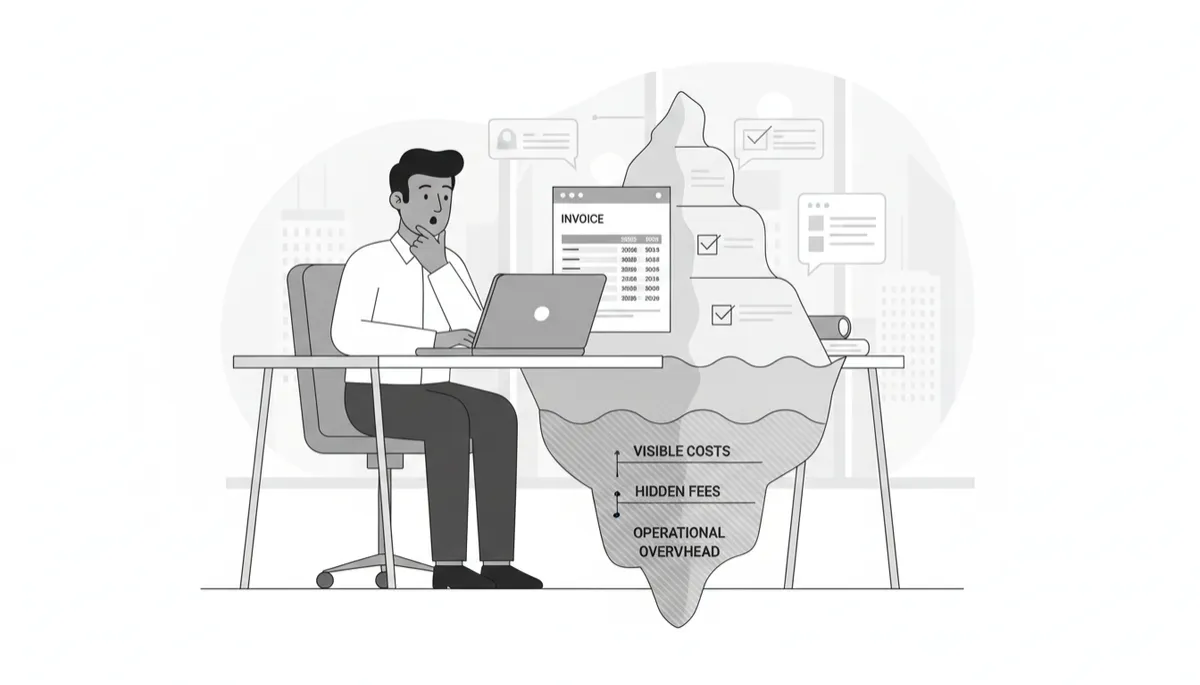
If you are asking “how much does an AI-powered CRM cost?” in India in 2026, the honest answer is usually between ₹800 and ₹25,000+ per month for a small business, depending on users and features. But that is only the sticker price. In most cases, the number you see on the pricing page is just the first layer of a much bigger bill that shows up over 12–24 months.
Research across CRM platforms shows that the seat cost (₹830–₹4,150 or $10–$50 per user per month for SMB tools globally in 2026) is only about 40% of your real first‑year spend. The remaining 60% hides in AI add‑on fees, implementation, training, integrations, and something I call the seat‑creep problem — your bill quietly inflating every time you hire someone new.
This guide is a transparent pricing education piece for budget‑conscious Indian business owners who want to avoid being surprised later. We will break down every layer of AI CRM pricing, show you how to build a realistic budget, and explain why a flat‑rate, all‑inclusive model like RevMax removes most of the uncertainty from your CRM line item.
The 3 Layers of AI CRM Pricing Most Owners Never See
When you look at any AI CRM pricing page, you are usually seeing only Layer 1. To budget correctly, you need to understand all three layers that make up your AI CRM total cost of ownership (TCO).
Layer 1 — The Base Subscription (the visible price)
This is the price everyone talks about: ₹800–₹4,000+ per user per month for most AI‑enabled SMB CRMs in 2026, with some enterprise‑style tools going much higher. This is what you see on the website: “Starter ₹X per user/month” or “Growth plan ₹Y per user/month, billed annually.”
Global benchmarks put the median entry‑level CRM seat price around $25/user/month (≈₹2,075) in 2026, with a range from $11 to $299 depending on the vendor and target segment. Multiple TCO studies show that license costs alone can be only a fraction of the real outlay over three years, sometimes just 20–30% of the true spend when you include everything else.
Layer 2 — The AI Add-On Fees (the surprise bill)
In 2026, most mainstream CRMs treat AI as a separate cost centre. You pay for the CRM, and then you pay again for AI usage, usually in the form of:
- AI credits that get consumed when you generate emails, summaries, or predictions
- AI “copilot” add‑ons charged per user on top of the base plan
- Usage‑based billing for specific AI agents or workflows (e.g., per recommendation, per call summary)
This is where many Indian owners get their first shock: the AI features that looked “included” in marketing often come with caps and overage charges. A few platforms bundle AI into the seat price, but the dominant trend is metered usage. If your team actually uses AI heavily (which is the whole point), your bill climbs quickly — sometimes by 20–30% beyond the advertised price.
Layer 3 — Implementation + Hidden Costs (the bill nobody mentions)
The third layer is where the real money sits. Industry benchmarks from analysts like Nucleus Research and others show that implementation typically costs 1.5–2x your annual license amount for SMBs. That includes setup, workflow design, integrations, data migration, and training. For complex, enterprise‑style CRMs, total cost of ownership over three years can be 3–5x the subscription cost when you add internal time and external consultants.
Add‑ons like advanced analytics, extra storage, API overages, and “premium support” can inflate budgets by another 30%. When you combine all three layers, the true first‑year cost of an AI CRM is often 20–40% higher than the advertised subscription — even for small teams — and the gap widens as you scale.
The Seat-Creep Problem: Why Your CRM Gets More Expensive Every Time You Hire
Most AI CRMs still price per seat — per user who logs in. That sounds logical until you start growing. Then you discover the seat‑creep problem: every new salesperson, telecaller, or support rep quietly inflates your monthly bill, whether they use the system deeply or not.
Let’s look at a simple example in Indian rupees, using a very modest per‑seat price of ₹1,500 per user per month for an AI‑enabled plan:
- 2 users: 2 × ₹1,500 = ₹3,000/month (₹36,000/year)
- 4 users: 4 × ₹1,500 = ₹6,000/month (₹72,000/year)
- 6 users: 6 × ₹1,500 = ₹9,000/month (₹1,08,000/year)
Moving from 2 users to 6 users — which is normal growth for a small Indian sales team — quietly triples your CRM license cost. And remember, this is before:
- AI credit overages when more reps start using AI features every day
- Extra implementation work to support more complex workflows
- Annual price escalations of 5–10% per year baked into your contract
A Realistic AI CRM Budget for Indian Small Businesses
To answer “how much does an AI-powered CRM cost” in a way that helps you actually budget, let’s look at three common scenarios for Indian businesses in 2026. These are all‑in monthly estimates spread over 12 months, including a realistic share of implementation and hidden costs — not just the sticker price.
1. Solo founder or 1–2 users
If you are a solo founder or a very small team, you will likely start on an entry‑level plan or even a free tier. But once you need serious AI features, automation, and WhatsApp/SMS integrations, you move into paid territory quickly.
- Typical base subscription: ₹800–₹3,000/month
- AI + hidden costs allocation: add 20–40%
Realistic budget: ₹1,000–₹4,000 per month for a solo founder who wants AI‑driven follow‑ups, basic automation, and light integrations without heavy consulting.
2. Team of 3–5 (typical early‑stage sales team)
This is where per‑seat pricing starts to bite. You want every rep on the CRM, using AI to write emails, log calls, and forecast deals. At 3–5 users, your license line item alone can easily reach ₹6,000–₹20,000 per month on mainstream tools, especially once you move beyond the most basic tier to unlock automation and reporting.
- Base subscription (3–5 seats): ₹6,000–₹20,000/month
- AI + hidden costs allocation: add 25–40% for AI credits, onboarding, and support
Realistic budget: ₹8,000–₹28,000 per month for a 3–5 person team that wants AI‑powered selling, pipeline tracking, and basic automation done properly.
3. Team of 10–20 (growing SME)
At this stage, you are likely moving into “professional” or “enterprise” tiers, especially if you want territory management, advanced reports, or custom objects. Seat‑based AI CRMs can easily cost:
- Base subscription (10–20 seats): ₹20,000–₹1,00,000+/month depending on features and vendor
- AI + hidden costs allocation: add 30–50% for AI usage, integrations, and admin
Realistic budget: ₹30,000–₹1,50,000 per month for a 10–20 person Indian SME that wants serious AI‑driven sales operations and reporting.
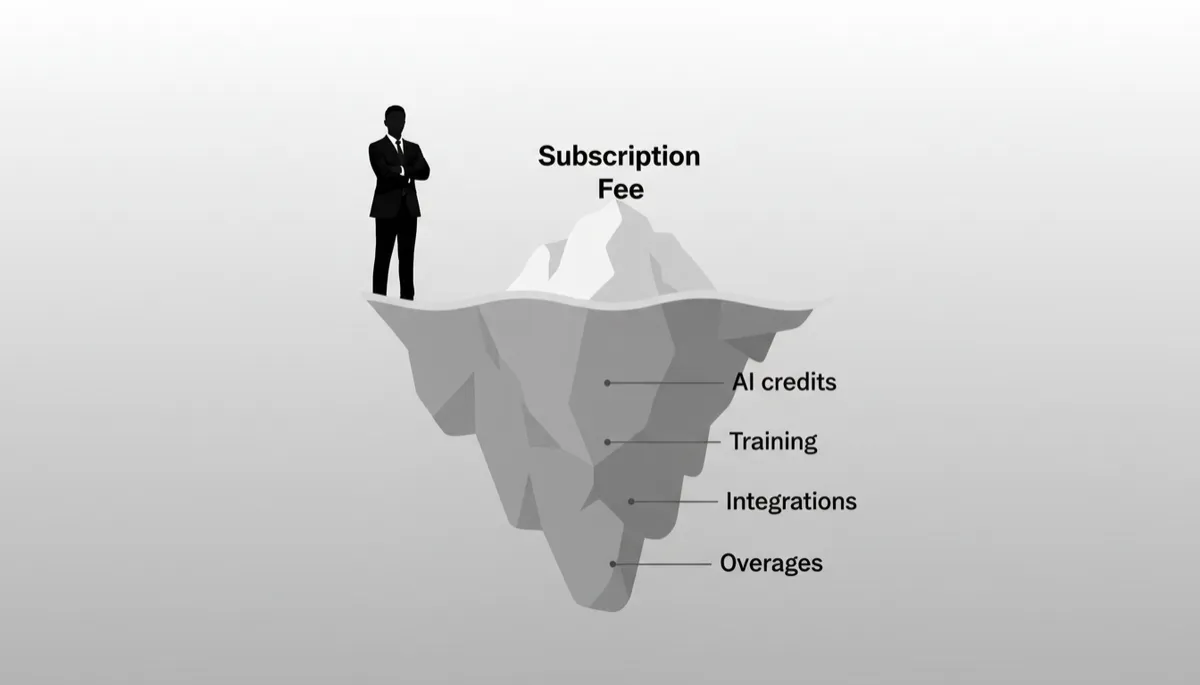
In most AI CRMs, the visible subscription is only a small part of total cost.
6 Hidden Costs of AI CRM That Aren't on the Pricing Page
Now let’s break down the CRM hidden fees India that quietly turn a “₹10,000 per month” tool into a ₹15,000–₹18,000 commitment by the time you are fully live.
1. Setup and onboarding fees
Many vendors either require or strongly “recommend” a paid onboarding package. For SMBs, this can range from a few thousand rupees to well over ₹1,00,000, depending on complexity. Analyst reports note that for some platforms, mandatory onboarding can add a significant first‑year premium on top of licenses.
2. Data migration
Moving from spreadsheets or an old CRM into a new AI platform is rarely “just a CSV upload.” You need cleaning, mapping, deduplication, and sometimes historical activity reconstruction. This can cost:
- Internal time: 20–60 hours of your team’s effort, which has a real opportunity cost
- External help: implementation partners or freelancers billing by the hour or per project
3. AI credit top-ups
AI features are fun — until you hit your monthly limit. Many AI CRMs include a base allowance of credits and then charge for:
- Extra email generations, call summaries, or forecasts
- High‑volume campaign runs or bulk enrichment jobs
For an active 5–10 person team, these AI top‑ups can add 10–20% to your monthly bill if not monitored carefully — and they are often buried in a separate “usage” tab, not on the main invoice summary.
4. Annual price escalation clauses (3–10%/year)
Many CRM contracts in 2026 include automatic annual price increases of 5–10%. Compounded over three years, this is not trivial. If you start at ₹50,000 per month and face a 7% annual increase, you are paying almost ₹61,000 per month by Year 3 — without adding a single new user or feature.
5. Integration and API overage charges
Connecting your AI CRM to WhatsApp, payment gateways, marketing tools, or your ERP often involves:
- Paid connectors or integration hubs
- API call limits and overage fees once your volume grows
For Indian SMEs running high‑volume WhatsApp or email campaigns, these overages can quietly add a few thousand rupees per month without any obvious warning on the main pricing page.
6. The adoption tax — the cost of a tool your team doesn't actually use
Perhaps the biggest hidden cost is non‑usage. Nucleus Research finds that CRM ROI can reach $8.71 for every $1 invested when systems are properly adopted. But they also note that adoption drops by 23% for every extra tier of unnecessary complexity. In plain English: the more bloated and complicated your CRM, the fewer people actually use it — and the worse your returns become.
How to Calculate Your True AI CRM Total Cost of Ownership
To budget like a CFO, you need a simple CRM cost breakdown that captures your AI CRM total cost of ownership over at least 12 months. Here is a practical formula you can use for your Indian business.
A simple 12‑month TCO formula
Total 12‑month AI CRM Cost =
  (Monthly subscription × 12)
+ (Average monthly AI usage fees × 12)
+ One‑time implementation & migration
+ Training & change‑management
+ Integration & API costs
+ Internal admin time (valued at salary cost)
Worked example: 5‑person Indian SMB
Imagine a small Indian company with 5 CRM users. They pick a mid‑tier AI CRM at ₹1,800 per user per month (₹9,000/month total), plus AI credits and basic implementation support.
- Subscription: ₹9,000 × 12 = ₹1,08,000/year
- AI usage fees: extra ₹2,000/month in top‑ups = ₹24,000/year
- Implementation & migration: one‑time ₹50,000 (≈0.5x annual license, conservative)
- Training & admin time: internal cost of ₹30,000 spread over the year
Total 12‑month cost: ₹1,08,000 + ₹24,000 + ₹50,000 + ₹30,000 = ₹2,12,000 for Year 1.
Notice how the headline subscription of ₹9,000/month (₹1,08,000/year) is only about 51% of the true first‑year cost. This aligns with industry findings that license costs often represent 40–60% of total CRM spend once you factor in everything else.
When Does an AI CRM Actually Pay for Itself?
Cost alone is not the full story. A slightly more expensive CRM that your team actually uses can be cheaper in the long run than a cheaper one that sits idle. According to Nucleus Research, well‑implemented CRMs can deliver $8.71 in revenue or savings for every $1 invested. The key word is “well‑implemented.”
AI time savings: 12 hours per week per rep
Multiple studies, including Salesforce’s State of Sales reports, show that reps spend a huge portion of their week on admin work. AI‑powered CRMs that auto‑log calls, generate emails, and update fields can save 10–12 hours per week per rep. For a 5‑person team in India, that is:
- 12 hours × 5 reps = 60 hours/week freed up for selling
Even if you value that time modestly at ₹500/hour, that is ₹30,000/week or about ₹1,20,000/month of productive capacity unlocked — far more than the CRM subscription in most SMB scenarios.
Payback periods: simple vs. complex platforms
Industry data suggests that complex, heavyweight CRMs often take 13–18 months to reach full ROI because implementation and adoption are slow. In contrast, simpler, focused platforms that teams can start using in days instead of months often see payback in 60–90 days — especially when AI is tightly integrated into everyday workflows instead of sitting behind extra paywalls or complicated setups.
For Indian SMBs, the financially smart move is usually to pick a CRM that:
- Goes live quickly (days, not months)
- Bundles AI into the core experience instead of metering every action
- Is simple enough that every rep uses it daily
What Flat-Rate AI CRM Pricing Looks Like in Practice
All of this brings us to a different way of thinking about AI CRM pricing: instead of per‑seat + AI credits + add‑ons, what if you could simply pay one flat fee that covers:
- Unlimited or generous seats for your team
- All core AI features included — no separate AI credit billing
- Fast implementation with minimal setup fees
That is the philosophy behind RevMax’s flat‑rate, all‑inclusive model. Instead of worrying about seat creep and AI overages, you know your CRM cost upfront. Your finance team gets predictable cash flows; your sales team gets to use AI freely without checking the “credit balance” every week; and you avoid nasty surprises at renewal time.
RevMax is designed for Indian businesses that want to go live in 30 minutes, not 3 months, with AI‑powered WhatsApp and sales workflows ready out of the box. If you are already working with a growth advisor or revenue consultant — for example, through Revenue Mastery Consulting or directly with Avinash N U — a flat‑rate CRM model makes it much easier to align technology costs with your revenue strategy.
Frequently Asked Questions
1. How much does an AI CRM cost for a team of 5 in India?
For a 5‑person team, typical per‑seat AI CRM pricing in 2026 might look like ₹1,000–₹3,000 per user per month, so ₹5,000–₹15,000/month in subscription. Once you add AI credits, implementation, and training, a realistic 12‑month budget is usually in the ₹1,50,000–₹2,50,000 range for Year 1. A flat‑rate model can compress that into a single predictable fee, often at the lower end of that range.
2. Are AI features included in the base CRM price or charged separately?
It depends on the vendor. Some bundle AI into the license, but many treat AI as a separate metered service using credits or per‑feature add‑ons. In practice, this means you often pay the base CRM price plus extra for heavy AI usage. Flat‑rate platforms like RevMax take the opposite approach: all AI features are included in one fee, so you are not punished for actually using the automation you are paying for.
3. What's a realistic ROI timeline for an AI CRM?
For complex, enterprise‑style CRMs, global benchmarks suggest 13–18 months to reach full ROI, mainly because implementation and adoption are slow. For simpler, AI‑first platforms that go live quickly and are easy to use, many Indian SMBs can see payback in 60–90 days, especially if AI is saving 10–12 hours per week per rep and helping close a few extra deals each month.
4. How do I avoid unexpected CRM costs?
Use a 12‑month TCO model before you sign anything. Include:
- Subscription × expected seats over 12 months
- AI usage estimates (credits, agents, add‑ons)
- Implementation, migration, and integration estimates
- Any annual price escalation clauses
Then compare that full‑year number across vendors — not just the per‑user sticker price. Or choose a flat‑rate CRM where the math is simple from day one.
5. Is flat-rate AI CRM pricing better than per-seat?
For many Indian SMBs, yes. Per‑seat models can work if your team size is fixed and you rarely use AI. But if you are growing, or you want every rep using AI heavily, flat‑rate pricing removes:
- Seat‑creep risk every time you hire
- AI overage anxiety when reps use automation aggressively
The cheapest AI CRM is not the one with the lowest per‑user number; it is the one that gets adopted, pays back in 60–90 days, and never surprises you with a bigger invoice. Flat‑rate models like RevMax are built with that philosophy.
Closing Thoughts: The Smart Way to Buy an AI CRM in 2026
If you remember only one thing from this article, make it this: the number on the pricing page is just Layer 1. For most Indian businesses, the real question is not just “how much does an AI-powered CRM cost” but “how predictable and fast is my ROI?”
Seat‑based CRMs with metered AI can work, but you must go in with eyes open about hidden costs, seat creep, AI add‑ons, and annual escalations. Build a 12‑month TCO model, pressure‑test it, and compare options on that basis — not just on the lowest per‑user quote.
Flat‑rate, all‑inclusive models like RevMax simplify this dramatically: one transparent fee, all AI features included, no per‑seat or AI credit surprises, and a go‑live timeline measured in minutes instead of months. For many Indian SMBs, that is the financially smarter way to bring AI into sales and marketing without turning your CRM budget into a moving target.
References & Links
- Freshworks CRM Statistics 2024: https://www.freshworks.com/theworks/company-news/crm-statistics/
- Nucleus Research — CRM and ROI Research: https://nucleusresearch.com/research/
- Salesforce — State of Sales: https://www.salesforce.com/resources/research-reports/state-of-sales/
- PMC/NIH AI‑CRM Study: https://pmc.ncbi.nlm.nih.gov/articles/PMC11382090/